We try to keep track of new developments with the posts we write, so that people can keep up with what’s going on in science. So if there’s a really significant update to something we’ve written in the past, we try to write about it.
We’ve talked about mantis and cockroach evolution in the past. Nancy wrote a post about how mantids are related to cockroaches, and I wrote about why mantids only have one ear. It’s likely they only have one ear because of their relation to cockroaches, and Nancy’s post does a great job explaining why scientists believe cockroaches and mantids are closely related to one another.
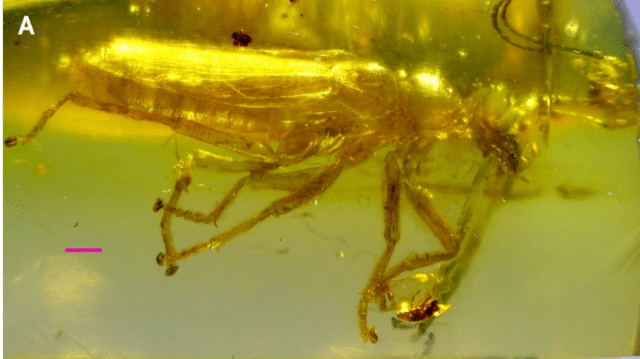
This week, a paper came out which added a new chapter to Nancy’s post on mantis evolution. Specifically, an extinct order of insects-appropriately called Alienoptera-was discovered which seems to have features of both cockroaches and mantids. It’s an evolutionary intermediate between the two, and it’s the sort of fossil that’s really important in figuring out how these insects are all related.
The short of this answer is that butterflies have a behavior where they sit on river banks, dead stuff, or poop and lap up the salts and minerals. It’s a behavior that can be seen in a few other insects like bees and flies, however is most apparent in butterflies.
Let’s take a further look into how and why butterflies puddle.
This question, received through our Facebook page, is one that actually hits close to home for me because it involves one of my scientific idols:
This dates back to a paper published in 2009, one which appeared in a legitimate scientific journal…and a pretty prestigious one at that. A paper in PNAS is basically a career-maker for most scientists. The citation for the paper is below:
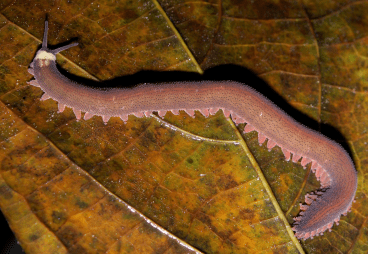
Onychophorans, or velvet worms, are distant insect relatives. Image credit: Geoff Gallice, via Wikimedia commons. License info: CC-BY-2.0
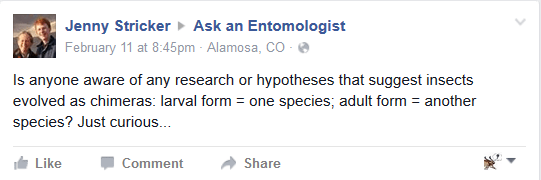
The idea that Williamson pushed in this paper, that metamorphosis evolved through hybridization of velvet worms and insects, was something he had been pushing for awhile. His ideas didn’t gain any traction until this particular paper was published in PNAS. It wasn’t well received, because many of his ideas were known to be false before the paper was published. Frankly, it should never have been published…especially not in a journal of this caliber.
The story of how this paper was published is actually really interesting for a lot of reasons, mostly because it’s a very harsh demonstration that your idols might not be perfect. It also gives us a great opportunity to talk about how scientists keep track of all the new discoveries that are constantly happening.
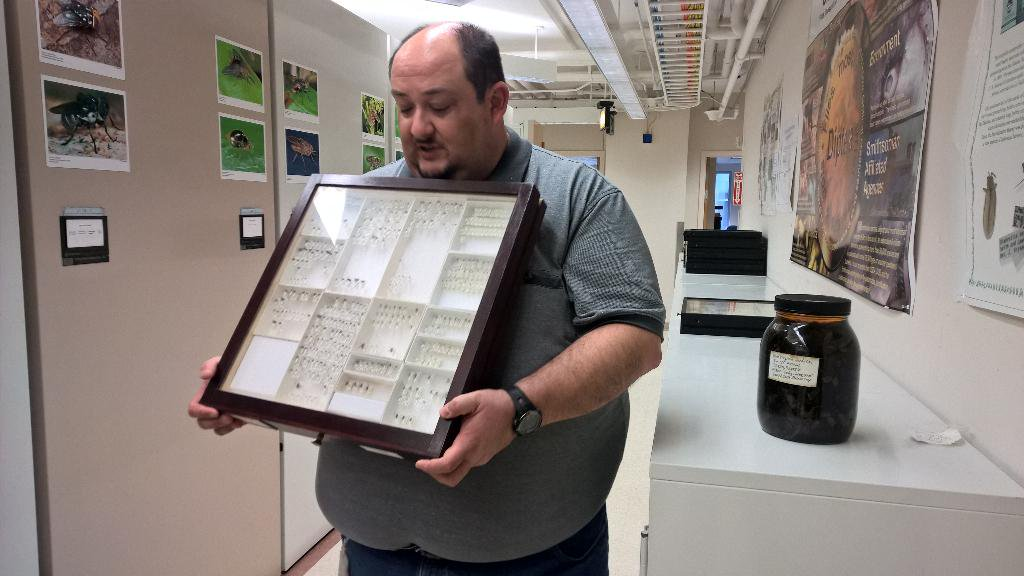
Basically, things showed up in boxes with with various bits of label data. Some of which is incomplete, some of which the specimens aren’t preserved properly, and some of which aren’t stored properly. This all kind of makes a big mess when trying to actually update and catalogue material. That is of course, if your museum has enough funding and people to actually do that. <<Spoiler Alert: there isn’t enoughmoney or peopleforthat.>>
There’s loads of unlocked and unknown specimens lurking in drawers, desks, cabinets, bottles, and bags that we just don’t have the manpower to sift through and identify, let alone catalogue.
But things haven’t changed that much. Things still show up in bottles, bags, boxes, old donations, and presumably lunchboxes that need to be sorted. So let’s go through the process, then and now.
That jar on the right has about 500,000 critters in it that all need to be sorted into boxes.
Here’s where we get to the meat of the question our follower asked…why use the antibiotic tetracycline as a switch? Why not something else?
Last week, we discussed a system which could potentially work for this sort of application by forcing mosquitoes to incorporate artificial building blocks into their biology. However, no research group has attempted to develop mosquitoes using Genetic Recoding technology.
@BugQuestions why use antibiotic? bc its understood? why not use a dietary nutrient mosq can’t easily acquire in nature?
To answer this, we need to look really deep into the biology of the mosquitoes Oxitec is using for RIDL. Specifically, we need to look at how insects are reared, how transgenic insects are created, and how different genetic switch systems work.
We’ve gotten this question, and it’s a really good question, but I didn’t initially understand what the person was asking. I knew what they were getting at-why is Oxitec using a tetracycline dependent system-but I wanted to wait for them to expand on this line of questioning before I started tackling it.
Removing nutrients from breeding grounds is impractical, because you have to find them in the first place. If you can find them, you can drain the water or treat the breeding grounds with mosquito dunks. A big issue with mosquito control is finding those breeding grounds, which can often be smaller than a tennis ball and lodged high up in a tree.
So the first part of the question, a part that’s only implied, is simply is it even possible to do this?
Randall Munroe totally understands the challenges of genetic engineering. Image Credit: Randall Munroe License info: CC-BY-NC-2.5
When making a chemical switch, you need to use something mosquitoes don’t need to live and which they won’t find outside. So switches activated by things bugs eat are off-limits, because you won’t be able to turn the system on/off in a reliable way. You might not be able to raise the bugs in the first place, or control in the field won’t happen.
You can, however, make the mosquitoes need something not found outside. There are only a few amino acids used in nature; most critters use the same 23 amino acids. There are also a few weird ones sometimes used by living things. Scientists have also created over 500 amino acids which are only found in laboratories. They’re not found outside, and most of these aren’t made by any organism.
So is there even a way to engineer a system that allows mosquitoes to be dependent on non-standard amino acids?
We’ve gotten a handful of questions about GMO mosquitoes via Twitter, and through an interview Joe did for a radio station (details of which are forthcoming).
So, we decided to switch the post midstream. We’re still planning on doing a post about what scientists do day-to-day, but the topic of GMO mosquitoes seemed a little more important. This is a topic we’ve written about before, so this time around, we want to focus on Florida and Brazil specifically.
Unfortunately, switching posts mid-stream is a little tricky. In order to do it right, we need to spend time reading the papers and deciding how best to tell the story. We can do it quick, or we can do it right…and we always choose doing a post right over doing it quickly.
The answer to this question involves not only a very complicated political situation, but also some very complicated chemistry and genetics. It’s not a thing which is easily explainable in a single post…and we really need to start by explaining the question itself. After we explain why this person asked the question (and this is a great question, by the way), we need to answer it. After we answer it, we need to explain what the answer means in relation to what’s going on in Brazil and Florida at the moment.
This question is a little bit like what Sarah Koenig tackles on the podcast Serial. The question begins small, and then spirals out in some very interesting ways. It’s just a very complicated question, that happens to be very relevant to something that’s really big news right now.
So bear with us on the late post. We’re trying to write an article that’s good, informative, and which contains the information people want. This takes time.
We’ll try to have something up this weekend, probably Saturday or Sunday. In the meantime, the information in the posts we linked here will help you understand our next few posts. It’s a very big topic, and it’s difficult to retread all this information in a concise way.
In the recent few weeks, the news has been filling up with stories about a new epidemic called Zika virus. Since it’s a hot topic, and potentially very important, I wanted to write something explaining what this virus is from a variety of perspectives.
We’ll get into this more during this post, but this is a giant ‘Oh, sh*t’ moment for public health. Before the events in Brazil, Zika virus was considered an obscure disease. People got sick, but it didn’t appear to kill anyone and it’s effects seemed to be transient. The reported connection to birth defects came as a complete shock to many, and quite frankly there’s no way anybody could have predicted this.
So let’s explore the biology of this virus, and the history of this disease.
Your Name: Alex
Your Bug Question: Hello. I love my pets very dearly. Sadly I am going to college and cannot take them with me. I believe a tarantula would be the best option because I plan to bring it home with me on breaks and I already have a snake and fish so I don’t have much room to work with. I would definitely be handling the tarantula a lot. Do you recommend any specific species that is really laid back and easy to care for?
We’ve received a few questions from people who wish to keep arthropods as pets, but aren’t quite sure where to begin finding information.
This is really understandable, because arthropods can make really complicated pets. Some are quite difficult to keep for a number of reasons, there’s a lot of ethics involved, and there are even some legal issues to consider. Knowing where to start can be a really challenging proposition.
So if you want to get a tarantula, or another arthropod, here are some things to consider…
Your Bug Question: I raise early season monarchs inside in New Zealand.(I bring the chrysalides inside because of our poor spring weather with heavy rains and gales).
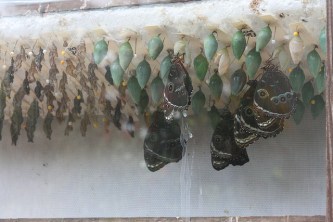
Yesterday 12 eclosed but 3 fell soon after. Fortunately I was there to assist and lift them carefully on to a stem they could hang from and dry their wings. 3 perfect butterflies.
My question is that 25% to fall seems high, is this normal, would they be able to help themselves if they fell on to the ground in a natural habitat outside? It appears the wings are too wet for them to even try to move and climb.
Thank you, Caryl
A lot of people rear insects for fun, or keep them for pets, and it’s only natural to want to do it well. So if you see something that’s unexpected, like the situation above, it’s only natural to be curious about what’s going on.
Pictured: Not what you’d see in natural conditions. Image credit: Nathan & Jenny, via Flikr License info: CC BY-NC-ND 2.0
Butterflies, when kept in captivity, are usually kept at relatively high densities. You might find one or two every ten square feet in nature, but in captivity you’re keeping dozens within a couple feet of one another. They might not act the way they act in nature, and things like falls have very different consequences in captivity.
Falls are probably common among butterflies in both nature and captivity, although no studies seem to have been done to look into this. If the wings are intact, I would imagine a fallen butterfly could recover pretty easily. It’s not uncommon to find a butterfly flying around, missing half it’s wing in nature. Butterflies are tougher than people give them credit for, and as long as they avoid predators I think they’d survive.
Insects can fall for a number of reasons, not all of which can be controlled by the keeper. It’s understandable to worry about diseases, but a fall doesn’t always mean something’s wrong. Like people, insects can sometimes be clumsy. Also like people, insects sometimes get sick.
For people who keep insects at home, I wouldn’t spend a whole lot of time worrying about disease. It can be tough to know if your bugs are sick. Diagnosing sick bugs like a doctor is challenging because, in some cases, diseased adults might just be weak and not visibly malformed. The University of Georgia has a pretty good website on one particular Monarch* parasite which causes deformities, Ophryocystis elektroscirrha. Sometimes adults are deformed, but sometimes they’re indistinguishable from healthy specimens. There’s some signs of infection you can look for on the pupae, but sometimes these signs can be hard to spot without a microscope.
There really isn’t a special laboratory bleach anyone uses. We use the stuff from the laundry aisle. Rubbing alcohol can work, too, but it’s not as strong as bleach. Image credit: Adina Firestone, via Wikimedia commons. License info: CC BY-SA 2.0
The best way to control pet insect diseases is sanitation: simply sterilize everything in the cage with a dilute bleach solution after every generation. Plant cuttings are how most diseases get into insect cultures, and sadly, there’s not a whole lot you can do about that. Unless you’re working with honeybees, there’s not really any medication for insects. Sanitation is really all you can do, so having the occasional diseased insect doesn’t mean you’re a bad keeper when you’re keeping insects at home.
To put Caryl’s 25% figure in perspective, some researchers estimate that only about 2- 10% of Monarchs* make it to adulthood in the wild. If you’re getting adults after feeding the insects on fresh plant cuttings from the proper host, and keeping them at reasonable temperatures, I think you’re doing just fine.
If you raise insects in captivity and are interested in knowing how many insects are just unable to grow properly…the number seems to be about 20-30%. The papers by Oberhauser and Altizer below report these numbers for Monarch* butterflies raised on leaf cuttings. Crop pests raised on artificial diets have about the same mortality, although I’m sure different groups have different success rates.
Assuming the butterflies are normal sized, not visibly deformed, and are able to fly when they come out, I think 3 out of 12 butterflies falling and surviving sounds somewhat normal. Unfortunately, I’m not there to inspect Caryl’s insects…but I wouldn’t assume anything was horrendously wrong unless they died before their wings dried.
The Bottom Line:
If we’re talking about rearing insects casually in your home, I think it pays to have a look into how it’s done on an industrial level:
If you’re rearing insects professionally (like Joe does), you’re going to have access to equipment that allows you to keep track of other metrics of success. Most scientists pay attention to mortality, but they also make sure the insects are a size that’s comparable to what you’d see in the wild. This requires specialized equipment, and statistics software. Most people wouldn’t have access to this-unless you want to drop $500 on a scale.
You don’t need any real fancy equipment to track the progress of your bugs. As long as you’re keeping the insects on the right hosts, keeping them at roughly room temperature, and getting adults which can fly away…you’re doing something right. You’re doing something you enjoy, and learning about the insect’s biology in the process.
Works Cited
Altizer, S. M., & Oberhauser, K. S. (1999). Effects of the protozoan parasite Ophryocystis elektroscirrha on the fitness of monarch butterflies (Danaus plexippus). Journal of invertebrate pathology, 74(1), 76-88.
Barrionuevo, M. J., Murúa, M. G., Goane, L., Meagher, R., & Navarro, F. (2012). Life table studies of Rachiplusia nu (Guenée) and Chrysodeixis (= Pseudoplusia) includens (Walker)(Lepidoptera: Noctuidae) on artificial diet. Florida Entomologist, 95(4), 944-951.
Oberhauser, K. S., & Solensky, M. J. (2004). Monarch butterfly biology & conservation. Cornell university press.
Oberhauser, K. S. (1997). Fecundity, lifespan and egg mass in butterflies: effects of male‐derived nutrients and female size. Functional Ecology, 11(2), 166-175.
*This information is for the American species Danaus plexippus, since I’m more familiar with this species. I do not know if OE, or an equivalent, is present in New Zealand Monarch species.




 Ask an Entomologist
You must be logged in to post a comment.