I love this project because sometimes we get completely random but interesting questions. Like where Mantis Kung Fu came from. Turns out there’s two distinct styles and many sub styles within them, so the answer is a bit complicated.
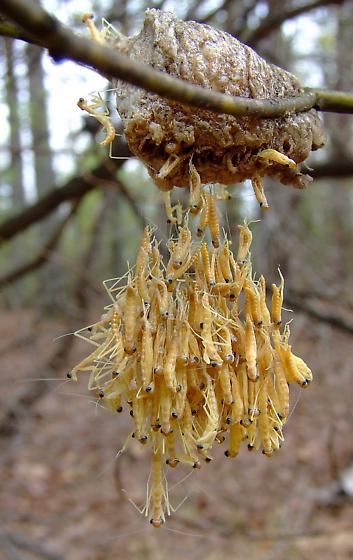
Mantids emerging from the ootheca. Within a few hours, the unlucky stragglers may be caught in a Battle Royale to see who’s the most hungry. Photo courtesy of Christina Borders (CC 1.0) from BugGuide.net.
Mantises, as we’ve seen, are interesting animals with a lot more going on than what it seems. They’re efficient predators which have an evolutionary history that many wouldn’t suspect, and they have their own weird biological quirks.
One habit in particular which interests people is the fact that these animals are very antagonistic towards one another. If you put more than one mantis in a container, someone’s going to get eaten before too long.
Sometimes, this happens with hatchlings. Right out of the ootheca, mantids are ready to go and have no qualms about eating siblings. Other times this happens during mating, with the female eating the male during the process.
Since we’re dedicating an entire month to mantids, it goes without saying that we should say something about sexual cannibalism as it relates to mantids because there’s a lot of mythology surrounding their mating habits. Their mating habits are also interesting to me because they defy a lot of assumptions which people have about animal mating habits.
The National Geographic video below discusses the standard way people think about mantis mating. Unfortunately, the video isn’t quite accurate. Mantis cannibalism isn’t very common, and what actually happens is a lot more complicated than the video lets on.
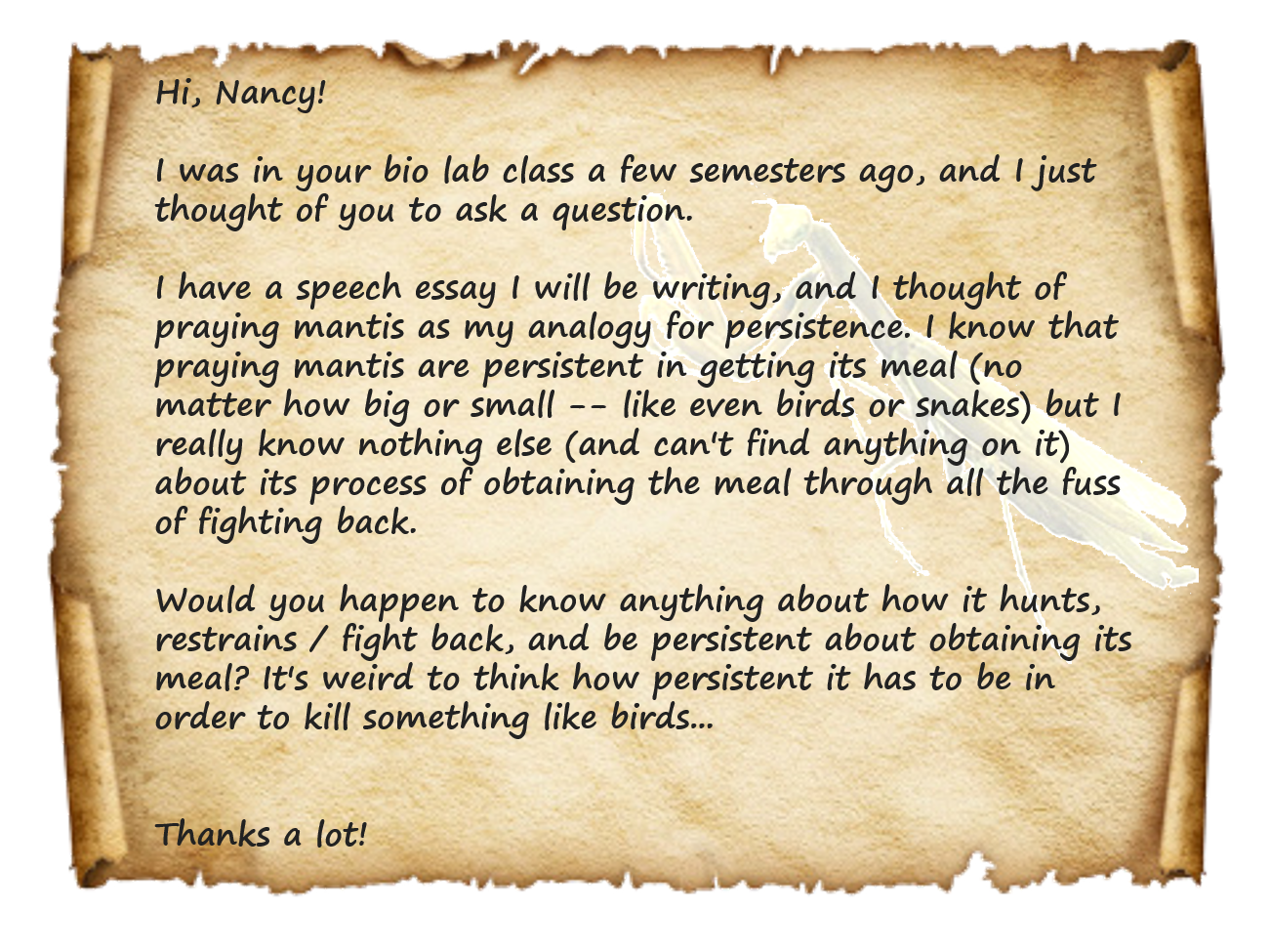
The other day I received an email from a former student about the persistence and strength demonstrated by praying mantises.
What I imagine e-mails to look like.
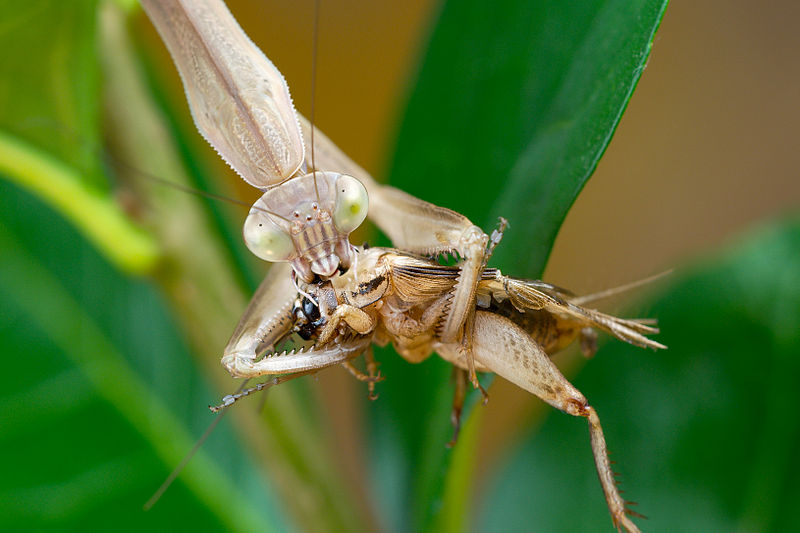
Yes, she did say birds. It is pretty amazing when you think about how mantises can capture hummingbirds! Praying mantises have a couple adaptations that make them such amazing predators. The first is their ecology, the second is morphology, and the third is biomechanics.
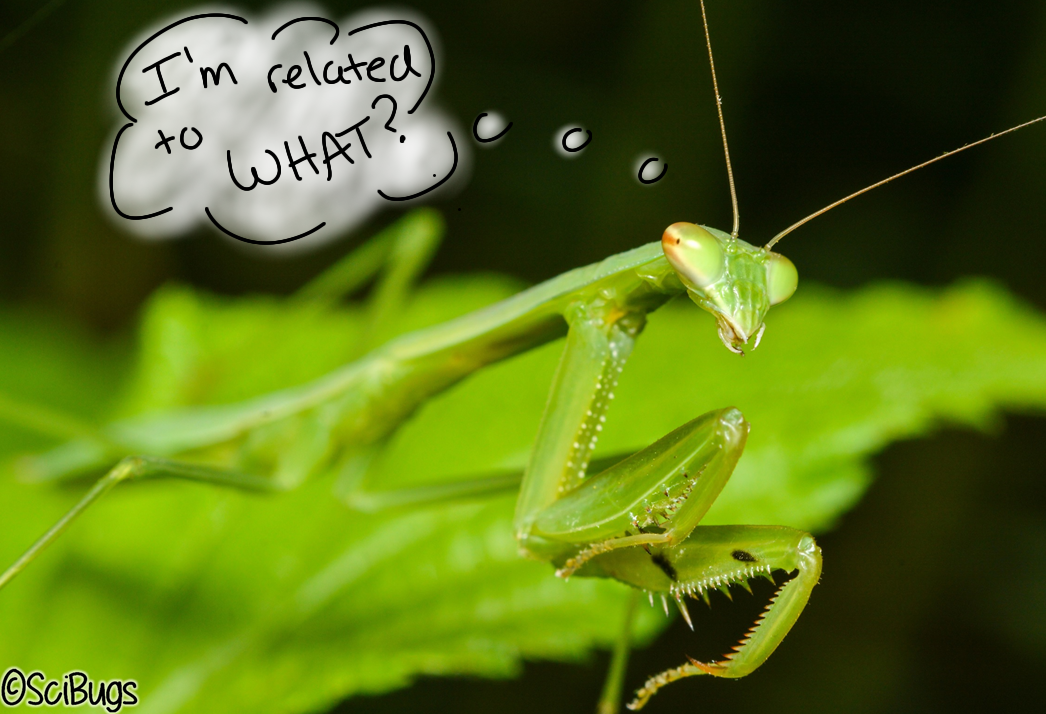
Cockroaches (Blattodea) and Mantises (Mantodea). They’re both insects. They’ve got their six legs, three segmented body parts, and a Johnston’s organ which guarantee them a spot in the class Insecta. But as it turns out, they’re more closely related than that.
@BugQuestions What's known about the evolutionary relationship between mantids and cockroaches?
In my opinion, one of the more interesting questions about mantids we received concerns how they hear.
As humans, we have two independently functioning ears which are located on our head. This works very well for us, and we use our ears for a number of reasons. We use them to communicate with one another, avoid danger…and for those who enjoy music, we use them for pleasure.
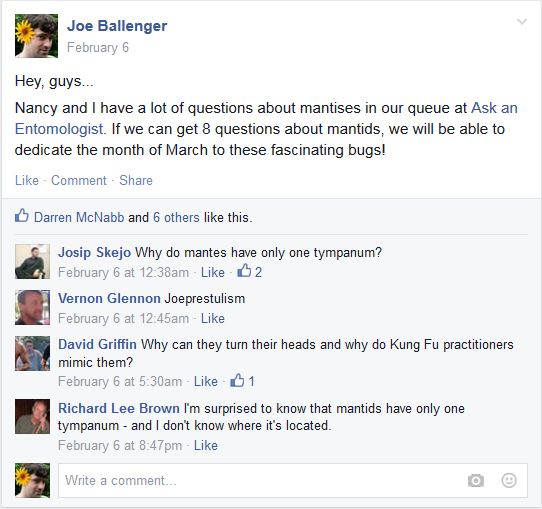
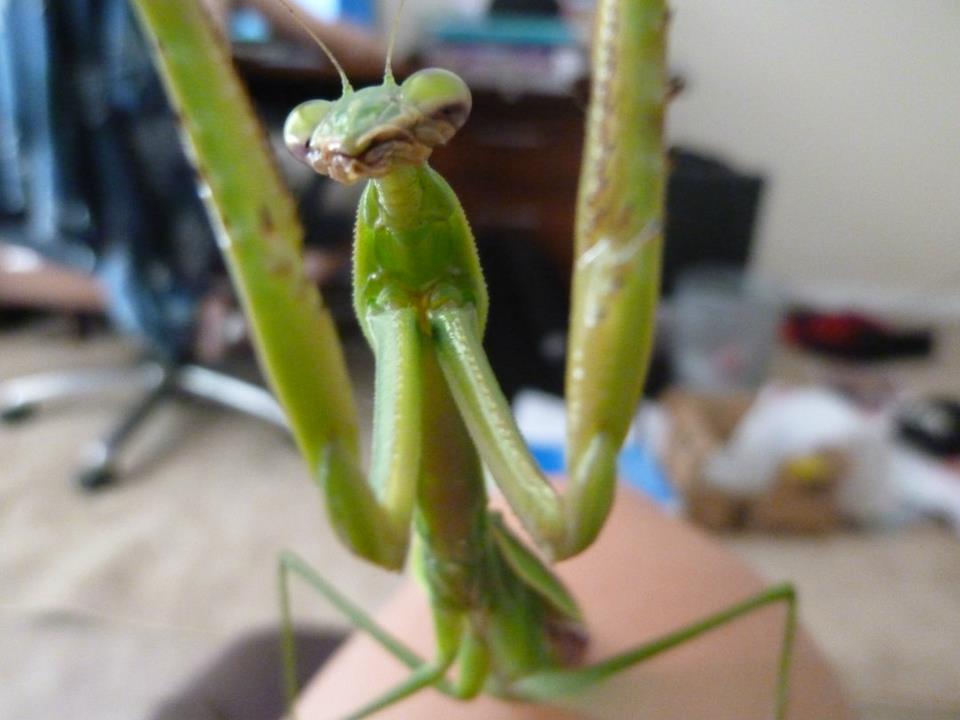
Mantids, in contrast, have one ear which is located in the middle of their chest between the legs. It would be comparable to having an ear located in the middle of the sternum.
So…why do mantids have such an unusual method of hearing?
Before we answer this question, we really need to back up and look at how insects use sounds. After that, we’ll talk about mantids specifically.
We get a lot of identification requests on our Facebook page, and we do what we can to identify them. Sometimes, these turn into interesting conversations…which in turn lead to good questions like this:
The moth in the picture above is most likely a Fall Cankerworm moth, Asophila pometaria. These moths are interesting because they’ve made an evolutionary trade-off which is uncommon in moths: the females have traded their wings for the ability to make more eggs. It’s a simple resource allocation trade-off: the larvae of this species are able to fly where they need to be. They use silk to get a lift on the wind, and they usually end up in the proper place. The females simply don’t need to spend the resources building wings.
Because the females can’t fly, they tend to wrap their eggs around sticks of their host trees as seen in the picture in this link. Sometimes, however, the females end up on a flat surface and they’ll make due with what they have…and they’ll lay eggclustersofvarious shapesandsizes and kind of hang out on top. Typically, they’re hexagonal but they can also be laid in long and narrow strips. It’s a ultimately a question of packing efficiency.
Many other insects, however, do lay eggs in specific shapes. Mantids-the insect group we’re focusing on this month-are an excellent example of insects which have specific egg laying patterns.
So why do mantids lay their eggs in specific patterns?
Everybody loves mantids. In fact, of all the questions we’ve gotten here on Ask an Entomologist, mantids are the insects everyone asks about. So it makes sense to dedicate an entire month to these big, beautiful bugs.
I’ve made it no secret that I love parasites, because they do some crazy cool things. So I was estatic when someone asked about mantis parasites, because I get to marry my favorite subject-parasites-with the obvious favorite insect of our readers.
As far as insects go, mantids are the apex predator because there’s not much that can mess with a full grown mantis. In fact I only know of one species of wasp, Stizus ruficornis, which specializes on mantids. Most other members of this genus prey on grasshoppers, which live in the same habitat.
Other than that, the only things which mess with adult mantids are vertebrates like bats and birds.
When you’re near the top of the food chain, you’re probably not afraid of predators. Instead, the things which are going to bring you down are much smaller than you. If you’re big, you’re more afraid of getting sick than getting eaten. This is why I think parasites are so cool: their whole thing is bringing larger animals down.
Mantids get a wide range of parasites, some of which are quite unusual. They’re attacked by wasps, flies, beetles, fungi and worms called Nematomorphs. It’s worth mentioning that a lot of these are very poorly known, and some of these have only been sussed out in the last few years. This means that some questions, like whether they’re host specific, might not have answers.
Spring’s right around the corner! Well, for those of us who aren’t heaped under mountains of snow. To kickstart spring, this month we’re going to post all about mantises! So shoot us your questions!
My pet mantis Tianna =D I’m bad at naming things though, so I just called her “mantis”. PC: Nancy Miorelli
Some of you who may like gardening may be planning on attracting a wide variety of insects to their garden if spring ever dares to show itself. We received a question about attracting mantises to gardens which sparked quite the discussion on Twitter.
In addition I was recently interviewed by the local Audubon Society about beneficial insects and gardening in general for their monthly newsletter. So I though this was a great opportunity to kill two birds with one stone.
So between llamas and a technicolor dress, the internet kind of exploded on Feb 26.
In the middle the dress as the picture was originally taken. On the left it’s been shopped to be white/gold and on the right it’s been shopped the other way. PC: Wired/Swiked
The dress in question is a lovely shade of … white and gold or blue and black. Or there was a popular third option. Who cares?
Neil deGrass Tyson had a perfect tweet about the whole dress thing.
If we were honest about shortcomings of human physiology then "optical illusions” would instead be labeled “brain failures”.
There have been a lot of takes on the dress from “what the hell is happening? Science!?” to “Haha jk lolz what color is this dress?”. I want to take this unique chance to talk about the power of optical illusions, bias, and how the world looks to things that aren’t us. The following examples do not take into account how good your color vision is, which you can test here.
Eyes are remarkable structures that have evolved independently at least three times. The most obvious advantage of eyes is that they help us understand the world around us by absorbing what is essentially data, which our brains then decode to tell us there’s a bus coming and to get out of the way.
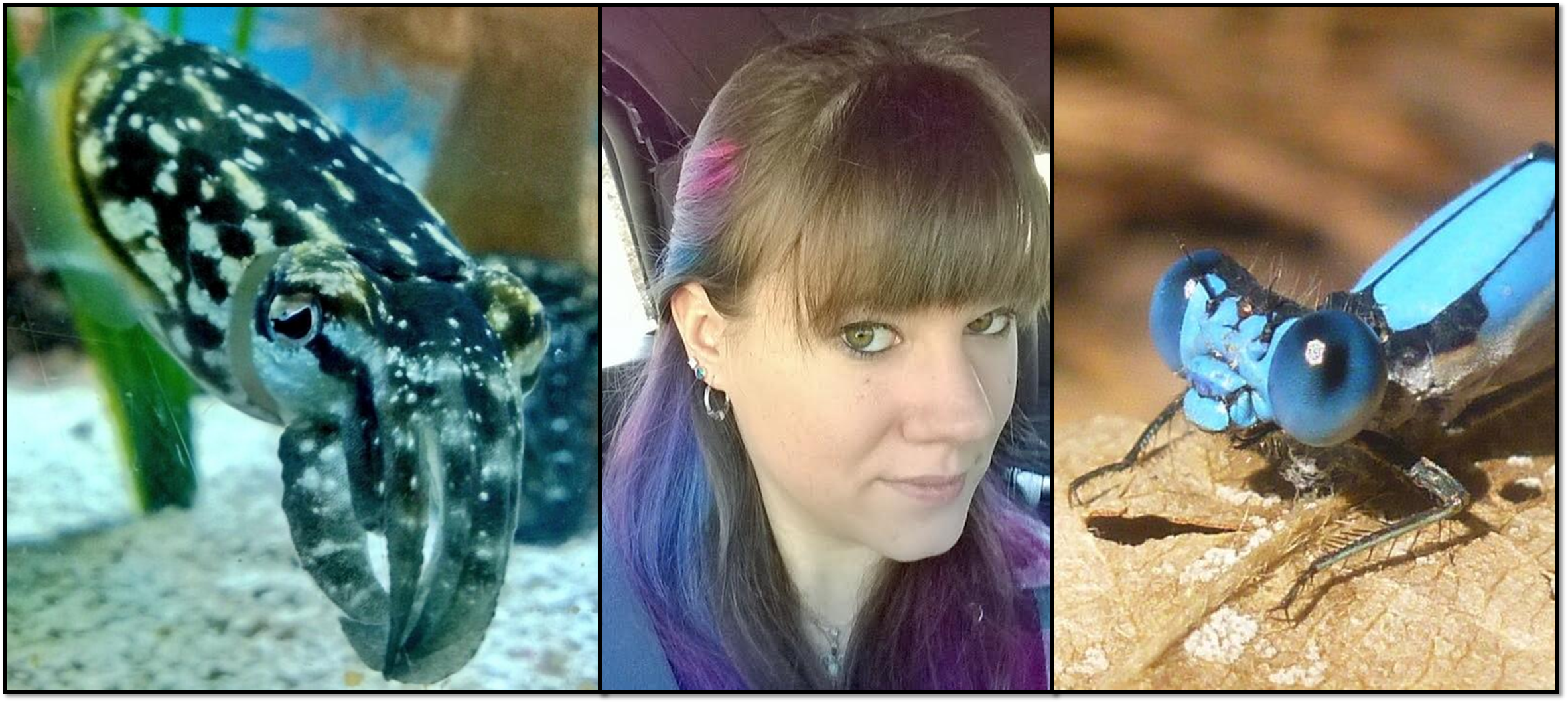
These three animals all have eyes but they all work in very different ways! PC: Nancy Miorelli
Well, the thing about evolution is that it doesn’t have to work perfectly – just good enough, like your perfectly average C student. The overall effectiveness and subsequent modifications to the compound eye is summarized very well by Nilsson.
It is only a small exaggeration to say that evolution seems to be fighting a desperate battle to improve a basically disastrous design.
Nilsson 1989
So, the benefit that the compound eye gives the fly is that the fly can see. It lets the fly know if something is coming towards it, where the fly is positioned in its environment, what’s there, and tells the fly that it’s moving in relation to other things.
A male Big Eyed Fly. Its entire head is a pair of eyes. (Diptera: Pipunculidae) PC: Marcello Consolo (CC BY SA 2.0)
But I’m assuming that that’s not *really* what the question is asking. So let’s get a couple things out of the way before we talk about what compound eyes do and some modifications that flies have made to them over the years.
Evolution isn’t picky about how things get done. So light sensing organs pop up and stick around because organisms that have them usually get less dead than things that don’t.
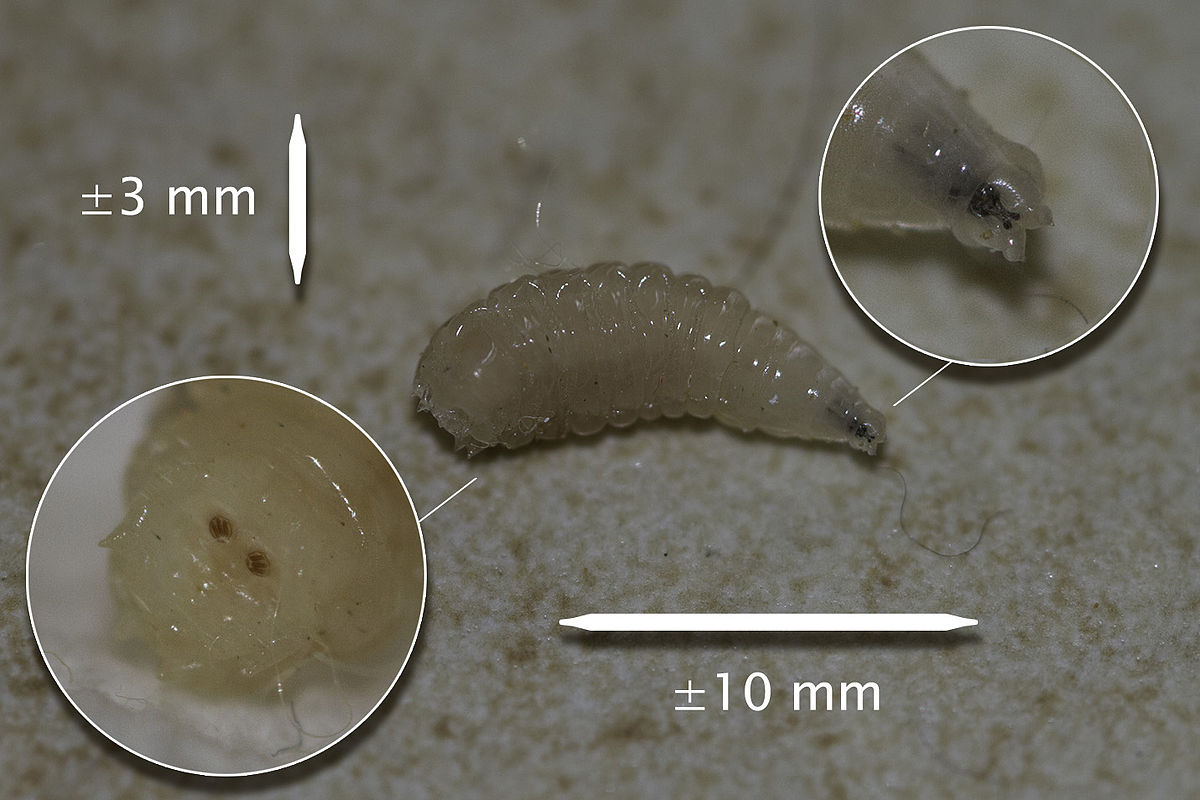
That is, of course, if the organism needs to see. Eyes are usually the first things to disappear if you live in caves. Or if you’re a fly maggot that invests its early days face first eating rotting corpses.
I’m a maggot and nothing more than a breathing digestive system. PC: CedricDW (CC by SA 3.0)
It’s not just flies that have compound eyes. All insects that have eyes have compound eyes. Many insects cheat and have both simple light sensing receptors and compound eyes.
This Dobsonfly has both compound eyes and ocelli. (Neuroptera: Corydalidae) PC: Nancy Miorelli
There are about 150,000 described species of described true flies (Diptera) with an estimated total number of fly species to be around 240,000. So, this is going to be very generalized and does not at all encompass every organism.
So let’s talk about the compound eye and how insects and specifically flies have tailored it to fit specific needs.






 Ask an Entomologist
You must be logged in to post a comment.