Facebug Challenge, Chibis, and New Houses – Ecuador Earthquake Relief Update

When I put out our plea for help a few days ago asking for aid after the recent earthquakes in Ecuador. I had no idea what was going to become of it. It’s always a little terrifying when you throw a pebble into the void and you don’t know if people actually see it or not.

But we raised $1,362 so far!

We can't tell you how excited and happy we are! Carlos says: Thanks for your support! Everything that was donated will be delivered and used for the people who really need it.

We can’t tell you how excited and happy we are!
Carlos says: Thanks for your support! Everything that was donated will be delivered and used for the people who really need it.

Cuz like really OVER 1,000 FREAKING DOLLARS!

And several donations came in to my house already and is packed!
We have over 50 pounds of clothes, shoes, and mosquito nets!
We got in feminine hygiene products and 300 water purification tablets too.
And my Dad said he’d pay for the truck to move things to the coast. 

But now we have a goal of $2,500 
With a stretch goal of $3,000.
Because we want to build homes.

Okay, but then with all this money that we got, I thought that maybe we could do something more sustainable than buy tents and provide temporary housing.
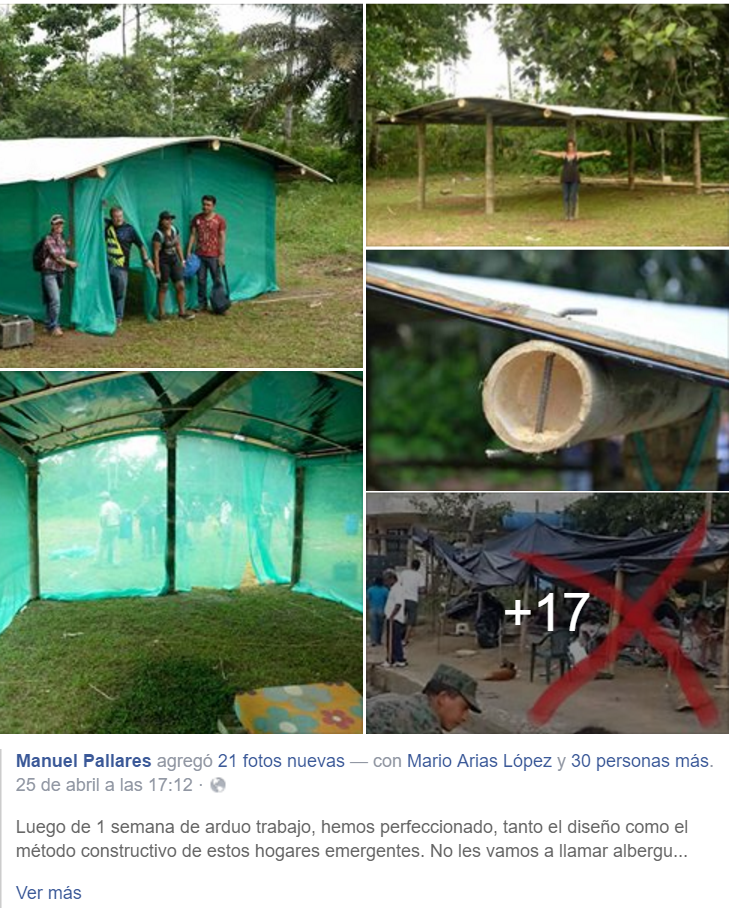
Remember those heroes I talked about in the last post? They're building these houses that have a simple cooling system and a simple water collection system made out of materials produced and found in Ecuador.

Remember those heroes I talked about in the last post? They’re building these houses that have a simple cooling system and a simple water collection system made out of materials produced and found in Ecuador.

So we thought, well – maybe we could build some of these. I marched my way over to Facebook to contact the two designers of this amazing system to see just how much it would cost.

And then we Skyped that very same day!!

And we talked about the logistics of where we would put these temporary houses and when we're going to do it.

And we talked about the logistics of where we would put these temporary houses and when we’re going to do it. Manuel and Christina are going to scope out the area May 5 to see exactly how we’ll construct the houses. Then on May 16 we’ll be going down there to actually build them. 

Carlos wants to help a small community where his family was affected called “Tres Vías el Mamey”. In this area, six houses  fell and people are living in structures like this.

Aunt

So we’re going to go build those semi-permanent casitas.

Continue reading

Posted in Culture, News | Tagged , , , , , , | 3 Comments

Shake It Off – Earthquake Relief in Ecuador

Hai!

You might remember me as one of the authors on this site, although in all honesty, internet-less jungle life has hampered my abilities to research and write articles. But I do surface from time to time to talk about some cool aspect of the insect world. (Spoiler Alert: It’s all Cool).

I live here, Internet is a thing that's hard to come by.

I live here, Internet is a thing that’s hard to come by.

But today, I’d like to talk to you about something that’s affecting my home. And it’s the earthquakes. Yes. “quakeS“.
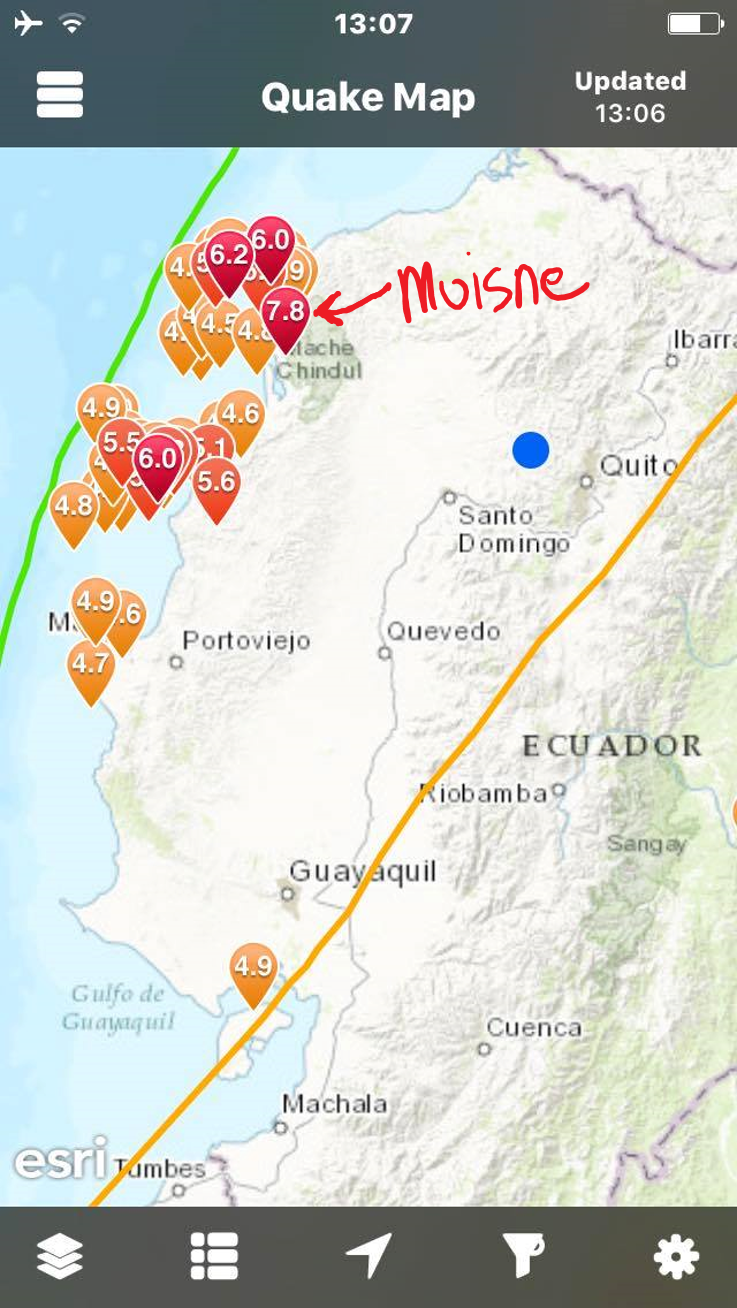
You probably heard about the 7.8 earthquake that struck a town called Muisne off the coast of Ecuador. Even though I was over 200 miles away, the lodge I’m staying at still shook for about a minute and I could *hear* the earthquake. It was like a clap of thunder, that lasted for a minute … and shook the building … for a minute. “Unsettling” is definitely the word I’d use for that.

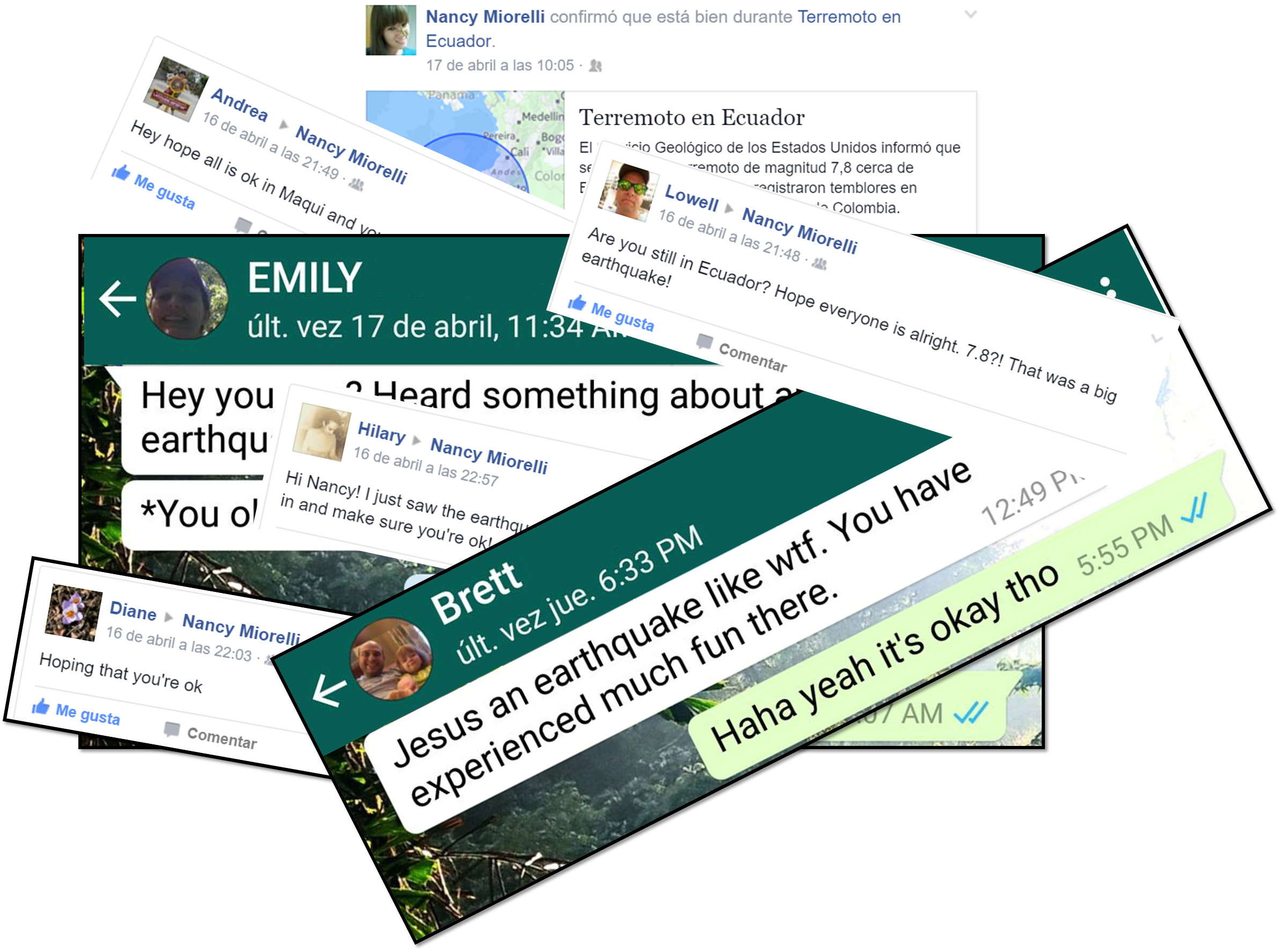
you okay

However, you probably haven’t heard about the other bazillion and a half earthquakes that have happened in the past week since then. In fact, there’s been so many that many sites and apps aren’t recording them anymore to try and decrease panic among the people.

As you might have imagined, I’m okay and I really do appreciate your concern. But today, I’m here to talk about my experiences with my best friend’s family who lives in Muisne.
And to ask for your help. I’m asking for the people who can’t.

The town of Muisne

The town of Muisne

I’ll be going down to the affected areas May with any donations that people want to send me and with the money that people would like to donate. You can send physical donations to my previous advisor at UGA and I’ll pick them up this week, or she’ll bring them down when the term abroad goes to Ecuador in June. Please write on the package that they’re donations for Ecuador.

To encourage you to consider helping me and my friends, I’d like to share with you a little photo adventure.

So let’s introduce the players.

Carlos and I have a lot of adventures together. Here is is teaching me how to ride the motorbike. Lots of faith since he apparently didn't buckle his helmet ...

Carlos and I have a lot of adventures together. Here he is teaching me how to ride the motorbike. Lots of faith since he apparently didn’t buckle his helmet …

In addition to running around on the motorbike, Carlos invited me to go to his parents house for New Years. They live in Muisne and I stayed with them for a few days. We also went back just a few days before the earthquake! It was probably one of the most awesome, but also culturally shocking experiences of my life.

We did lots of fun things!

We went to the beach! This is how you get around the town. Well, I'm a little to big for this town, apparently,

We went to the beach! This is how you get around the town.
Well, I’m a little to big for this town, apparently.

Continue reading

Posted in Culture, News | Tagged , , , , , , , , | 1 Comment

How long have cicadas been around?

Your Name: Thomas
Your Bug Question: How long have cicadas been around (on earth).  Do we (you) know?

Magicicada

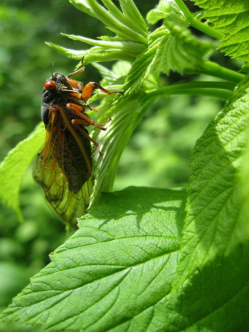
Magicicada, captured in June 2014 at Ledges State Park in Boone, Iowa. Picture Credit: Joe Ballenger

Cicadas have been around somewhere between 40 million and 200 million years. The earliest Cicadas are found in fossil beds from the Jurassic period. Of course, the answer kind of depends on how you want to define what a cicada is. The term ‘Cicada’ is a common name which is derived from a scientific name.

Cicadas are a part of their own superfamily, the Cicadoidea. This superfamily encompasses two living families: The Cicadas (Family Cicadidae) found worldwide, and the Hairy Cicadas (Family Tettigarctidae) from Australia. Although these insects look very different, they are actually very closely related. There’s also a bunch of extinct families.

The Cicadas most people are familiar with appear about 40 million years ago. The Australian Hairy Cicadas are much older, about 200 million years. I know that’s a lot of wiggle room, but this group of insects has an odd quirk of the fossil record that I think is kind of interesting.

For figuring out when this group of insects evolved, it’s the Tettigarctids which are important. In terms of their body plan, they lack some of the features that the Cicadas found everywhere else have. Specifically, they lack the equipment to make sounds humans can hear. They also have setae-hairs-sticking out all over their body.

In the fossil record, it’s actually kind of hard to tell exactly when the Cicadids split from the Tettigartids. These insects have very unique legs adapted for digging, and they’re difficult to mistake for anything else. So you can tell a Cicada just by the front pair of legs alone, and Cicada fossils are actually somewhat common.

Cicada exoskeletons

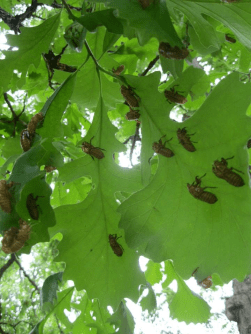
Cicada exoskeletons, from Magicicada emergence in 2014. Picture credit: Joe Ballenger

However, the reason Cicada fossils are common is what makes this difficult to answer. The final molts, or exoskeletons, of Cicadas are left behind when they turn into adults. They’re easy to crumble, but don’t decay very much. It’s just an exoskeleton, so they don’t make a good meal.

So this group of insects has left scientists with a lot of incomplete fossils which are hard to sort out. In other words, there’s bits and pieces of what look like Cicadas all over the fossil record…but these fossils are only fragments. The definitive fossils, the ones we can ID with certainty, are spread kind of far apart. Specifically, the two groups are spread about 140 million years apart.

So while the oldest Cicadid fossil-the ones that most of the world knows-is about 40 million years old, there are much older fossil legs which look suspiciously similar to those of modern Cicadid species. These could be as old as 100 million years.

The Bottom Line

Cicadas used to be a really diverse group of insects, but most lineages have gone extinct over the ages. We’re left with the Cicadas which lived with the dinosaurs, and one of the newer families which evolved much later. It’s possible that the dinosaurs we saw in the Jurassic Park movies heard the same sounds we hear on a summer day. It’s possible, but we don’t know for sure.

Works Cited

Grimaldi, D., & Engel, M. S. (2005). Evolution of the Insects. Cambridge University Press.
Posted in Evolution | Tagged , , , , | 3 Comments

Why do some insects pee sugar?

Anastasia question

So let’s unpack this one, because insect pee (watery poop, actually) is really interesting in every way. Here’s a video of what Anastasia was talking about:

If you want to see more insects doing this, look for Insect Honeydew on YouTube.

Hemipterans, insects which have peircing-sucking mouthparts, are a really big group of insects. They’re one of the five so-called ‘megadiverse’ orders, which are the groups of insects which have the most species. They’re the only one of these groups of insects which doesn’t go through complete metamorphosis.

Lanternfly

Spotted lanternfly, a really pretty invasive insect. Photo credit: USDA, via Flikr. License info: CC BY 2.0

One of the keys to their diversity is their feeding style, the Hemipterans all make a living by liquefying their food. Living on a liquid diet seems simple at first, but these guys can do anything the ‘chewers’ can do. There’s predators, parasites, herbivores, and each of these guys can eat any part of their hosts. In fact, it’s really hard to figure out what these guys eat because they eat so precisely.

Spotted lanternflies, a newly introduced species, feed on a plant liquid called phloem. Phloem is a sugar-rich liquid used by plants to transport nutrients. Lanternflies, and other insects like aphids, tap into plant veins.and suck out the sugary liquid inside. This liquid is passed out as a watery sugar-rich substance called honeydew.

So why do some insects poop sugar?

Continue reading

Posted in Physiology | Tagged , | 3 Comments

What happens when two queen bees meet?

Your Name: Dominic

Your Bug Question: Hi, I have a question in my head that I know only an Entomologist can answer. it’s about bees. I tried searching for answers on the internet haven’t found any.

My question is, What will happen if several Queen Bees are placed in one container?

Will they cooperate? Or kill one another?

How about if in a hive. the original queen bee was taken and replaced by a new one? or several one?

Bees have this reputation as a paragon of animal cooperation, and it’s well deserved in some ways. In other ways, not so much.

The video above shows two newly emerged queen bees fighting to the death. The interesting part is that this is normal…queens killing each other is hardwired into honeybee biology. Queens can be replaced, either by the beekeeper or through natural processes when the queens get too old. Workers will eventually adopt new queens if the original queen is removed or if she dies…but queen bees will *not* tolerate each other.

So the short answer to this question is ‘yes’…queen honeybees kill each other. This is a pretty uniform response, mated and unmated queens fight. Virgin queens fight. I’m not sure if mated queens fight when they encounter each other, but it would surprise me if they didn’t.

This question is pretty easy to answer for the honeybee, Apis mellifera. They have a pretty uniform response, because they’re what scientists call strongly eusocial. Their social structure is well defined, and the entire colony acts more or less as a single unit.

Here’s the thing, though. Bees are a huge group, with really complicated relationships. Honeybee social structures don’t actually represent what you see in all groups. Some bees are solitary, others nest in communities, and there’s a lot of strongly eusocial bees as well. So if we want to talk about the different ways that bee colonies interact, it pays to discuss different social structures of bees.

As luck would have it, there’s one bee species where all these different social structures are represented. I think Halictus sexcinctus, a European sweat bee, is a great system to contrast with the honeybee. Depending on where it’s found, it can be solitary, communal, or eusocial.

So how do queens interact in different groups of social insects?

Continue reading

Posted in Ecology | Tagged , , | 6 Comments

Zika virus update

Written by Joe Ballenger

An important paper came out in the journal Science, which I think is a great update of the Zika virus situation in Brazil. Here are the highlights:

Microcephaly and Zika

Microcephaly vs population.JPG

  • The correlation between Zika cases and microcephaly, when measured in relation to live births is weak, but statistically significant.
  • Overdiagnosis due to increased reporting and inconsistent definitions of microcephaly are still very important factors that could skew results.
  • Zika virus appears to be transmitted between mother and fetus
  • Cell culture studies show that Zika infects and kills cells that will differentiate into neurons, although animal studies still need to show that Zika can cause microcephaly.
  • These results still only demonstrate correlation, and do not demonstrate causation.
  • Although the virus is evolving, there is no evidence that any genetic change has led to increased virulence or pathogenicity. The changes so far all look like so-called silent mutations.

Zika Introduction to Brazil

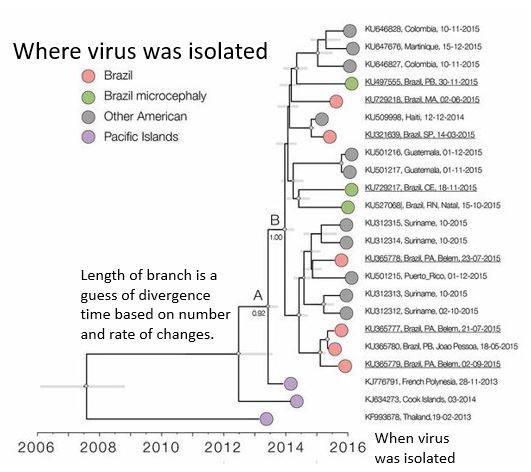
Zika evolution

  • The strain of Zika virus circulating in Brazil is related to the strain which was responsible for the outbreak in French Polynesia
  • The viruses all form one cluster, which implies a single introduction. However, multiple introductions still can’t be ruled out.
  • Three hypothesis remain about potential introduction sources. The most likely point of introduction was the 2013 Confederations Cup soccer tournament, which had competitors from French Polynesia. However, this doesn’t match up with the French Polynesia outbreak timeline.

The Bottom Line

I’m still following the Zika outbreak, but I’m trying to be very careful with what I post. There’s a lot of rumors going around, and I really don’t want to spread wrong information. So updates will come, but will be very infrequent.

Science takes time, and it’s imperative that it’s done *right* even if it’s not done fast. Our knowledge of the situation is evolving, but these studies don’t come nearly as quick as we’d like to see. That’s the nature of science, though…things are always slow.

Works Cited/Image Credit:

Faria, N. R., da Silva Azevedo, R. D. S., Kraemer, M. U., Souza, R., Cunha, M. S., Hill, S. C., … & Rocco, I. M. Zika virus in the Americas: early epidemiological and genetic findings.
Posted in Evolution, News | Tagged , , | 1 Comment

Do insects get trapped in water drops? Why aren’t they constantly drowning?

Frankwmcarr

Question: Is it true that very small insects (e.g., ants) can get trapped inside water drops due to the high surface tension forces of water?

We got this question in the comments of Nancy’s post, What do Bugs do When it Rains?

Also, in our email, was this question:

Your Name: Mohammad

Your Bug Question: What happens when moth’s wings get wet ? Can they fly afterwards, or they’re damaged for good ?

I view these questions as related, because they deal with the consequences of getting wet.

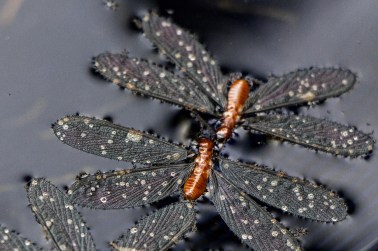
Termites1

Termites who landed in a birdbath. The relatively large surface area of their wings had adhered to the surface tension, and effectively trapped them on the surface. Image credit: KenMcMillan, via Flikr. License info: CC BY 2.0

Free-standing water is an everyday part of the environment. When people think of free-standing water, lakes and rivers are what usually come to mind. These are important habitats, but there are also other sources. Dewdrops in the morning are a big one, and plants can produce water in the form of guttation drops.

In captivity, free-standing water is also an issue. Larger arthropods, like tarantulas, can be watered using what amounts to a mini dog bowl. However, when culturing small insects, water droplets are deadly more often than not. Smaller insects also need to drink, and can end up trapped in the water droplet.

In captivity, water presents a special issue for moths. If the side of the container is wet, they can brush up against the sides of the container. The water sticks to the scales, and pulls them off. The scales are somewhat important for flight and species recognition in the wild, so this would be bad for them.

For other insects, like springtails…water is not a problem so long as they don’t get submerged. They can play on water droplets all they want, because they have built-in water repellents.

For that matter, larger insects also need to have a way to deal with water. After all, if you’re camping out all night (as bugs always do), you’re going to wake up covered in dew every once and awhile. This is a problem for butterflies and moths, due to those scales.

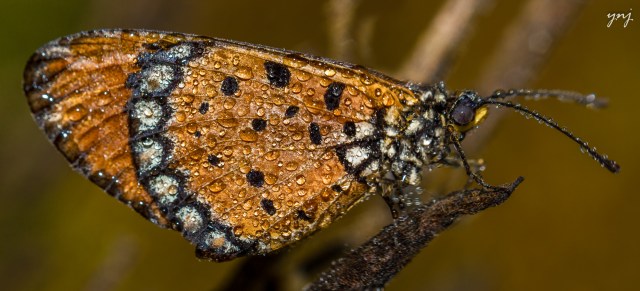
Dew covered butterfly

This is fiiiiine. I’m fiiiiine. Image credit: Yogendra Joshi, via Flikr. License info: CC BY 2.0

So to answer the first question…yes, smaller insects can (and do) get trapped in water droplets and drown. That, however, leads us into the second question…why aren’t insects always drowning? Why aren’t they constantly glued to themselves because of water?

Why do delicate structures, like scales, stay on wings if surface tension is such a big deal to tiny animals?

Continue reading

Posted in Ecology | Tagged , , , , | 3 Comments

Questions about head lice.

Written by Joe Ballenger
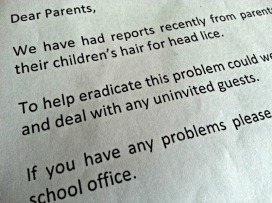
Head Louse note

Image credit: Chez Mummy, via Flikr. License info: CC-BY-SA-2.0

We get a lot of questions about lice, and these are really important. On Biofortified, I wrote an article about head louse treatments that was relatively depressing. There are a lot of companies which market louse control products under loopholes that exempt them from safety and efficacy testing. I also suspect some companies misrepresent which ingredients are the active ingredients. I’ve always wanted to revisit this topic, because that post needs an update, but I don’t think I’d be able to safely do that in today’s blogging climate. Interference, the scary type, is a scary reality in today’s blogging world. All I’m going to say on that topic is this: always use FDA-approved treatments.


So here are a number of questions we’ve gotten through email. Due to the somewhat sensitive nature of lice infestations, they’ve been anonymized as well as decontextualized. These questions are from multiple emails, and any potentially identifying information has been removed.

Continue reading

Posted in Education, Pest Management, Physiology, Research | Tagged , , , | 4 Comments

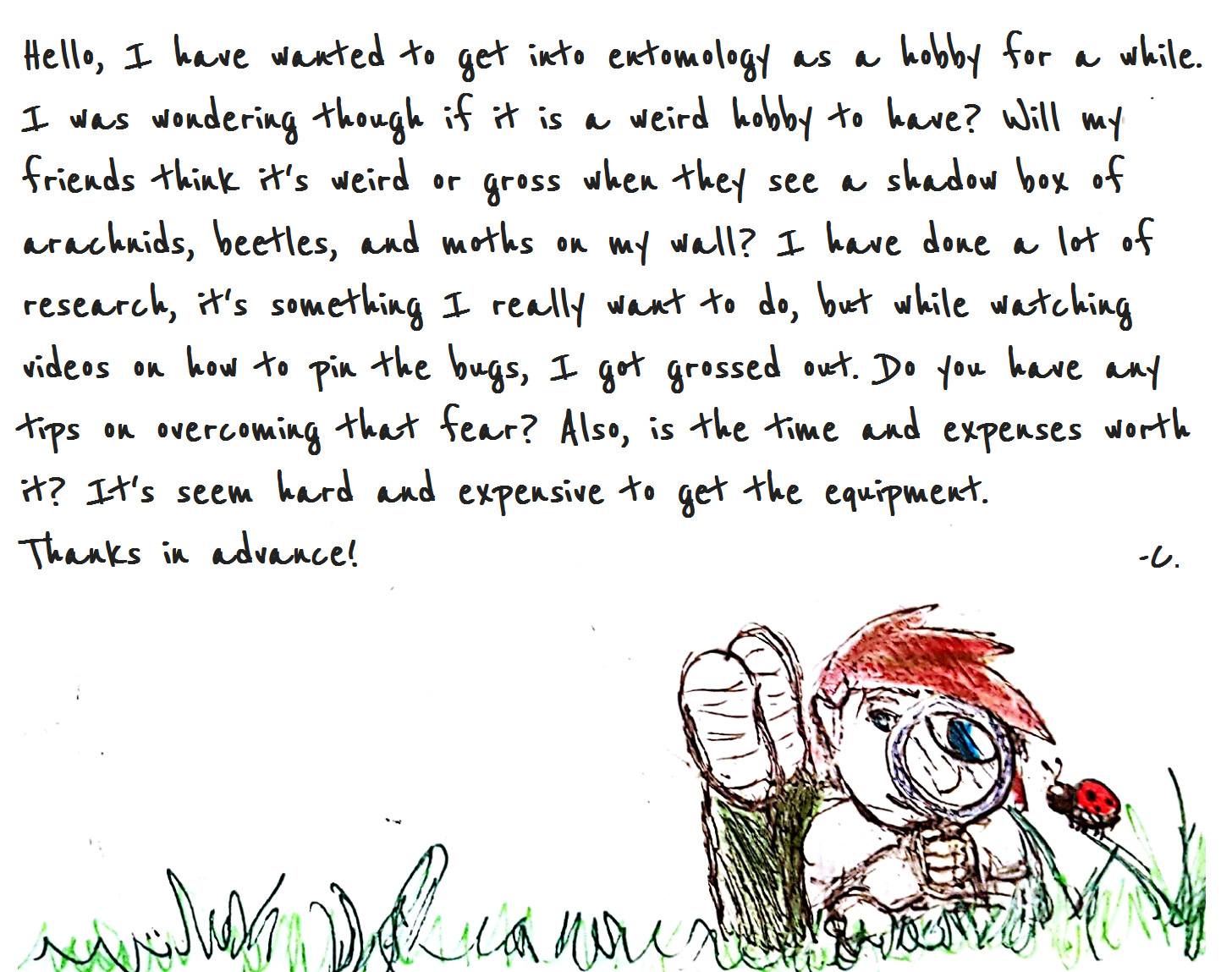
The Entomologist Hobbyist

question

Let’s jump right on in there. First of all, it seems to me that you’re really interested in Entomology! You’ve told me twice in this short email how you’re excited to get started, so jump on in there!! As long as your hobbies are legal, your friends should support you in pursuing your interests.  I obviously don’t think that entomology is a weird hobby to have. I don’t think it’s weird to have an interest in our natural world. I don’t think it’s weird to want to further your knowledge in a field that you might not otherwise have a background in. And if anything, you can be rest assured that at least 50,000 other people share your interests in our entomology FB group, so you’re definitely not alone. In fact, this might be a great opportunity to meet some new people! And this might be an even better opportunity to show your friends how cool the little world of bugs is.

If you’re ready to get your feet wet in entomology, lets talk about some things you can do with collections and getting into entomology on a budget.

Continue reading

Posted in Culture | Tagged , , , , , , , | Leave a comment

Hooks, Graspers, Spikes, and Stalkers … Oh My! How [Some] Insects Have Sex

Written by Nancy Miorelli

I’d give this post a PG13 rating.
Please don’t take dating advice from insects. Keep everything consensual in your love life.

And now, everything you ever wanted to know about insect sex. Actually, that would take too long, so here are a few highlights.

The list for animals that we know enjoy sex is rather short. We can start that list with humans and probably end it with bonobos, capuchins, macaques, and dolphins.  There is evidence that sex is just a thing animals do to make babies but actually being able to determine if they like it or not is a bit more challenging. It’s something we usually do with muscle spasms, behavior, and facial expressions. Things that don’t work well for insects.

I concede that “enjoying” sex isn’t the same as it just not hurting. I also concede that both of these are different than “Ow! That hurts!” So lets look at some insect examples.

I'll just hang on here for a ... while. You're chill with that, right? (Male is on top) PC: Nancy Miorelli

I’ll just hang on here for a … while. You’re chill with that, right?
(Male is on top)
PC: Nancy Miorelli

Continue reading

Posted in Ecology | Tagged , , , , , , , , , , | 6 Comments