How can you tell how old a caterpillar is?

Written by Joe Ballenger

For the final entry of the year, I decided to tackle a question that is something that I have a lot of experience with, but one is also really challenging to answer at the same time.

From: Jessica

Does this caterpillar change its skin colour when its about to go to the coocoon stage? How would we be able to tell how old the caterpillar is? Is there way to tell the age?

The caterpillar Jessica sent us was one of a Tussock moth, a species I don’t have any experience raising. So we couldn’t answer the question, but I did want to write a post about how to tell the age of caterpillars. It’s a really important topic.

When you’re doing research on insects, you need to be able to tell whether they’re growing properly for a number of reasons. If you’re testing insecticidal proteins or new diets (which is what I do), you need to be able to tell if your protein is stunting the caterpillar’s growth. If you’re looking at host-parasite interactions (which is what I did to earn my degree), the caterpillars need to be at the proper stage because parasites usually only attack caterpillars at very specific parts of the lifecycle. This is a skillset which is integral to the scientist’s toolbox.

When I was in graduate school, I handled hundreds of caterpillars every day. Nowadays, I handle thousands. Weighing each caterpillar individually would be impossible for my current job. Consequently, I need to be able to do this by sight without the use of any tools.

So how can you tell how old a caterpillar is, and more importantly, why is it hard for scientists to do it over the internet?
Continue reading

Posted in Developmental Biology, Physiology | Tagged , , , , | 1 Comment

Why do social insects die facefirst in the nest?

Written by Joe Ballenger

First and foremost, I’m really glad we got this question:

From: Katharine

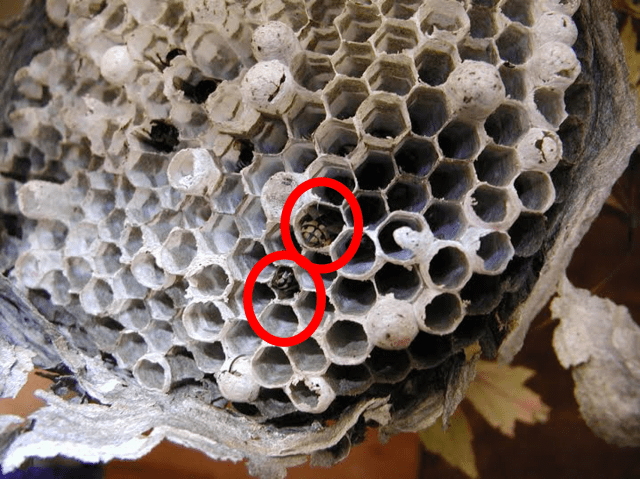
I’ve been keeping an eye on a wasp nest in my grandmother’s yard for a while. Since we just had a cold snap, I went to check on it to see if the wasps were dead so I could harvest the nest. The bottom half was gone (we’ve had some strong storms here, which may be the cause) so when I took it down, I could see the cells of the nest. Some of the cells appear to still have caps (I’m assuming they were dud eggs), but in a lot of the open cells, there are the empty exoskeletons of the adult hornets, all with their abdomens sticking out of the cells and most with the end of their abdomen broken off. There are other adults in the same position but with complete abdomens that I’m guessing are also dead. What’s going on here? Do wasps return to the cells they grew up in? Do they sleep there?

Dead Dolichovespula

Picture credit: Katharine, from the AaE inbox. Picture modified from original by Joe Ballenger

By now, the bugs are in the process of dying down for winter. If you’re in The North, the frost has killed them off already. If you’re in The South, that might not have happened yet. Insect season is almost over, for the most part.

If you’re really lucky, you can find some really neat artifacts the bugs left behind. The nests leftover from baldfaced hornets are really popular, because they’re pretty cool looking. I’ve never been lucky enough to find one myself, but that doesn’t mean I don’t look.

If you bring one inside, you should freeze it immediately. Otherwise, you might get an unpleasant surprise. Sometimes pupae take a little bit longer to develop due to the cold-but-not-lethal temperature, and that can translate into a living room full of confused wasps.

Sometimes, you’re lucky enough to find a nest…but it’s been broken apart first. If you look inside, you might see some of the previous inhabitants laying headfirst in the combs:

So why do wasps die that way?

Continue reading

Posted in Behavior, Ecology | Tagged , , , | 1 Comment

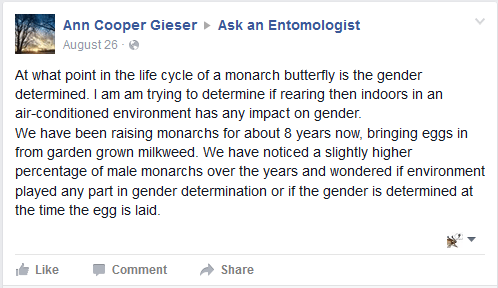
How do butterflies make boys and girls?

Written by Joe Ballenger

We’ve gotten a lot of questions about boy and girl bugs. Nancy wrote a post titled Is that Bug a Boy or a Girl, which covered some general rules about how boy and girl bugs are different. We also got a question about how this works in bees.

Awhile back, we got a question about how Butterflies make boys and girls…and these guys do things a little bit differently than the other critters we’ve discussed.

Monarch sex det

Sex determination in insects is really cool, because there are so many different ways to make boys and girls. Each type of insect has a different twist on the same thing, and different groups within these types can even make boys and girls in completely different ways.

This is also really important for a lot of reasons. Some mutations which result in pesticide resistance are sex-linked in some insects, and this influences how these genes move through the populations. From a technological perspective, you need to know how boys and girls are made so you can make sterile insects. Sterile bugs would be great because they show great promise in reducing pesticide applications in agriculture, especially in developing nations.

Even though this question was asked about Monarchs specifically, this is really important stuff to know!

So how do butterflies and moths make boys and girls?

Continue reading

Posted in Developmental Biology, Evolution, Physiology | Tagged , , , | 2 Comments

What have we learned about science communication over the past year of answering your questions?

Written by Joe Ballenger and Nancy Miorelli

We recently got back from the Entomological Society of America’s annual meeting, where we were invited to give a talk about Ask an Entomologist.

We’re both young professionals, so this is a big opportunity for us for a lot of reasons. One of the big things is that we get to talk shop with other science communicators, and do something that will help schools create outreach programs. Nancy discussed what we do at meetings in We’re on an Adventure! ESA 2015, and we had a great time.

We’re a pretty unique project because we’re a blog that’s driven by our audience. We are a ‘safe place’ where people can ask any sorts of questions about insects they want, and that’s not only important to us…but also to the future of science. We specialize in dealing with things people outside the scientific community are interested in. This also gives us a pretty unique opportunity to look for patterns in the sorts of questions that people ask. People learn about biology from this blog, but we also learn about the sorts of things people are interested in.

During our first year, we’ve actually noticed a lot of interesting patterns which could help new science communicators know what to expect.

So…what have we learned? Continue reading

Posted in Education, Research | Tagged , , , , , | Leave a comment

Why can’t you buy a jar of fireflies? Or: What factors decide which insects are sold online?

One of the neat things about this project is that we get some questions that are asking about things in a very narrow sense, but hit on some really important and interesting topics which are very relevant in a broader sense. Take this question, for instance:

Your Name: Bev
Your Bug Question: Here’s a question I’ll bet you’ve never seen! I am interested in growing some Kermes oak (Quercus coccifera), in the hopes that I can introduce the kermes insect (such as kermes vermilio) to adopt it’s favorite host plant. I know I can purchase the oak to plant in my yard, but I’m wondering if there’s a way to find and purchase live bugs (or larvae, or eggs, or anything that will grow and live)? Help!

We did answer this question in private, and the short answer is that I don’t think they’re available for sale to the general public.

…but why is that?

Another person asked a very similar question over #BugQuestions on Twitter:

I think these two questions are really cool because they hit on a topic I honestly did not anticipate ever talking about when we started this blog. On the surface, they appear to be asking about acquiring specific insects…but in reality they’re talking about economics.

You can buy insects online, but the kinds of insects which are available fit some very specific criteria.

So what decides whether certain insects are sold online?

Continue reading

Posted in Culture, Economics, Education | Tagged , | 9 Comments

Why don’t spiders have wings?

Your Name: Anarely
Your Bug Question: Hello,
I was wondering, why are the exact reasons that spiders don’t have wings? Is it possible for them to evolve and get them or what is stopping this from happening?

I’m sure the very thought of winged spiders would send some corners of the internet into fits of terror, but if you think about it…spiders really should have wings.

The vast majority of insects have wings, even if they’ve lost them along the evolutionary way. Insects use wings for things like finding new food sources, fleeing from predators, finding mates, and dispersing to new areas. These are things spiders do, as well.

Not only do spiders have a need to do things like disperse to new areas, and find new food sources in times of need, many spiders do this by taking to the air in a process called ballooning. They extrude silk out of their abdomens, and use it kind of like a kite to bring them somewhere else.

However, the major disadvantage of ballooning is the relative lack of control over where you end up. You’re pretty much at the mercy of the elements, and can’t really control where you eventually land.

Another area where wings could help is the direction of falls. Some flies and damselflies hover to steal spiders out of their webs…but Portia uses a dragline to ambush her prey.

Some spiders need to spin webs across huge chasms, and again, silk comes in really handy here. They let out a really big line of silk, which attaches somewhere random, and then crawl across that line to reinforce it and spin their webs.

So even though spiders take care of some of their needs through flight, they have a really inefficient way to do it. They could really use wings, but don’t have wings.

So why don’t spiders have wings?

Continue reading

Posted in Behavior, Ecology, Evolution, Physiology | Tagged , , | 5 Comments

We’re On An Adventure! ESA 2015

Written by Nancy Miorelli

Hello from Minneapolis!

Bobak Ha'Eri (CC by SA 3.0)

Bobak Ha’Eri (CC by SA 3.0)

Joe and I have been really busy at the Entomology Society of America conference, doing what we like most: listening to other people talking about cool science and talking to people about cool science.

Joe and I were working on our talk for tomorrow this afternoon!

Joe and I were working on our talk for tomorrow this afternoon!

What Is a Professional Conference?

Continue reading

Posted in Culture, News | Tagged , , , , | 1 Comment

The mystery of the old stable: Why are there flies all over the place?

Written by Joe Ballenger

Flies can be tricky to talk about. There are well over 100,000 described species, and it’s likely that there’s at least one million which haven’t been described yet. Most are small enough to not be noticed, but some do show up in large numbers in people’s houses. These are usually scavenger species associated with people.

So when we get a question like this…

Your Name: Sheree
Your Bug Question: We have an 80 year old barn that we tore down to the bare wood and replaced with siding and insulation and interior wood walls. The whole barn I would say is not tight, some small areas where bugs can come inside. This summer we have an infestation of flies!! Bombed twice in 2 weeks and still have live flies. what else can we do? Pest control comes out and sprays inside and around the base of the building. Worst year for flies!!!

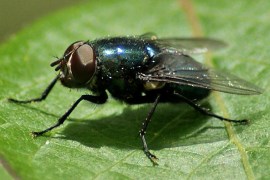
…I tend to think that they’re blue-bottle flies or house flies, which live in trash or manure.

Blue-bottle fly, also known as a blowfly. Likes: long walks on rotting corpses. Dislikes: Earthworms Image credit: DRSPIEGEL14, via Flikr License info: CC BY-NC-ND 2.0

Blue-bottle fly, also known as a blowfly. Likes: long walks on rotting corpses. Dislikes: Earthworms
Image credit: DRSPIEGEL14, via Flikr
License info: CC BY-NC-ND 2.0

If you hear hoofbeats, you’re usually dealing with horses. When you hear about flies around the house, the assumption is that you’re dealing with a common species like house flies or blue-bottle flies. That’s usually what you’re dealing with.

Usually. Not always. Flies are weird, so a thorough description of the environment can really shed light on this situation.

Later in our conversation, Sheree clarified:

Hi Joe,
The barn has been restored to a shop with no livestock in it. New wood inside and out except original hardwood frame which is now covered with new wood. We live beside a farm with cattle. And we have horses on the other side, at least 300 + feet on either side of this barn.
I am a Veterinarian, that is why I am asking you. Nothing dead or dying here, just flies!
Thought you might have some new ideas….

So let’s set the stage for this mystery. We’ve got an old building, a lot of flies, and no rotting matter to attract them. So they’re not house flies, or blue-bottle flies. These hoofbeats belong to zebras, not horses.

I’ve heard of an identical situation.

It’s a major plot point in The Amityville Horror.

The Amityville incident is largely assumed to be a hoax, and I am not suggesting this structure is haunted. However, I do think Sheree is experiencing the same biological phenomena which inspired that scene from this movie. I think that because the scene in the video above is based on a real phenomenon which commonly happens in old buildings.

So what’s going on here? Why do mysterious flies sometimes show up in old structures?

Continue reading

Posted in Behavior, Culture, Ecology | Tagged , , | Leave a comment

Black Out: How Do Insects Survive the Winter

Written by Nancy Miorelli

What if the world went suddenly dark? Or cold? Or both? We all know what fate the dinosaurs had, but what would happen to insects?

We got this one in our email from Devin

Before we get going on a wild goose chase through a tunnel of “What If’s” let’s look at some examples throughout geological history and some modern day insects to help us get an idea of what’s going on.

Continue reading

Posted in Ecology, Evolution | Tagged , , , , , , , , | Leave a comment

Mythwits podcast: How do parasites do the whole mind-control thing on their hosts, and does this happen in people?

Written by Joe Ballenger

Recently, we had a chance to do another awesome podcast with the wonderful guys at Mythwits. First, I should probably mention that this is a very casual podcast…which means it’s Not Safe for Work. Besides the Mythwits crew, we were joined by John Cmar who studies infectious disease at Sinai hospital in Baltimore, MD.

We got the chance to discuss how different parasites take control of their hosts, which is a topic I’ve always found interesting. In fact, it was reading about this topic in the book Parasite Rex which was a big part of getting me into entomology. Nancy tackled the question from an ecological standpoint, I tackled the question from a physiology standpoint, and Cmar took on the question from a medical angle.

I did want to give a brief summary, for those who may not want to listen to the NSFW podcast.

Continue reading

Posted in Physiology, Podcast | Tagged , , , , , , , | 1 Comment