Wait, Insects Breathe!? But How? Part I

Post by Nancy Miorelli and Joe Ballenger

One day, while puttering around on Twitter we noticed that there was a #BugQuestions already…and there are some really neat questions here. The question of how insects breathe is one which is commonly asked, and it’s one which deserves some serious consideration!

Continue reading

Posted in Ecology, Physiology | Tagged , , , | 4 Comments

What Happens Inside a Cocoon or Chrysalis?

Written by Nancy Miorelli
Well, there's quite a lot to cover here! So lets get to it!

Well, there’s quite a lot to cover here! So lets get to it!
Click for full size

This is a great series of questions because I was going to tackle a butterfly coloration question this week, but would have had to talk about development. Now I can talk about development and we can learn all about pretty shiny butterflies next week.

Sooo, how do we make pretty, shiny butterflies?
Continue reading

Posted in Physiology | Tagged , , , , , , , , , | 9 Comments

What happens to insects when they die of old age?

Written by Joe Ballenger

Corrigan Vaughn

I think this is a really neat question for many reasons. Getting older is something we all deal with, and the person you were 5 years ago is not the person you are today. For everything our life begins, we grow, we develop and then we die. After seeing shed skins, learning about butterflies, or reading about the horrors of parasitoids, people are aware that insect development is most unlike our own. Regardless of whether you emerged from an egg, or survived live birth, we all inevitably meet the same fate.

Almost every living thing dies…so how do insects die?

Continue reading

Posted in Physiology | Tagged , , | 6 Comments

The Budding Relationship of a Midge and the Chocolate Flower

Written by Nancy Miorelli
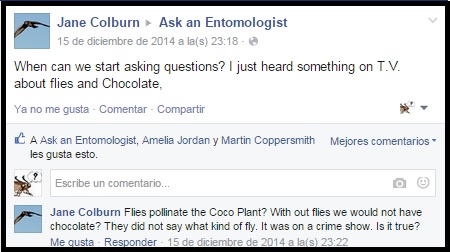
Chocolate and Flies?

Chocolate and Flies?
Yes, my Facebook is in Spanish because I’m trying to learn it.

Short answer – Yes,  but it’s impressive the system works at all.

Where Does Chocolate Grow?

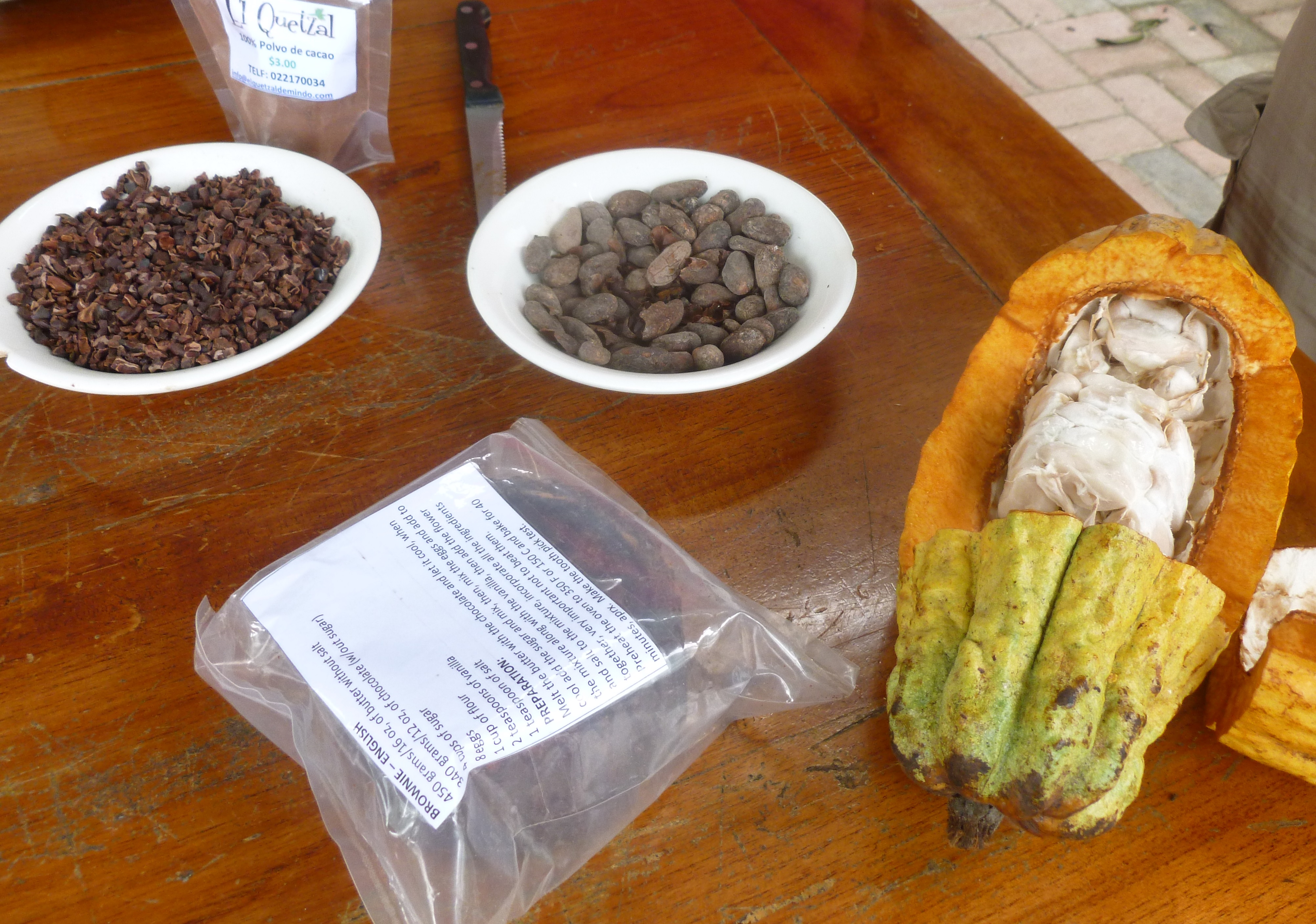
Chocolate in Ecuador. From the pod to the candy.

Chocolate in Ecuador. From the pod to the store.

Chocolate, or the Cacao plant (Theobroma cacaogrows all over the world but mainly in the tropical regions. Chocolate is grown in West Africa, Indonesia, Central and South America, and in Hawaii. This presents a challenge for chocolate production, because the pollinators also have to be found in these regions which are very different from one another.

How does the Cacao plant get pollinated? Let’s take a look at the involved parties.

Continue reading

Posted in Ecology, Pollination | Tagged , , , , , | 4 Comments

Why do entomologists kill insects? A non-taxonomist’s perspective.

Co-Written by Joe Ballenger and Nancy Miorelli

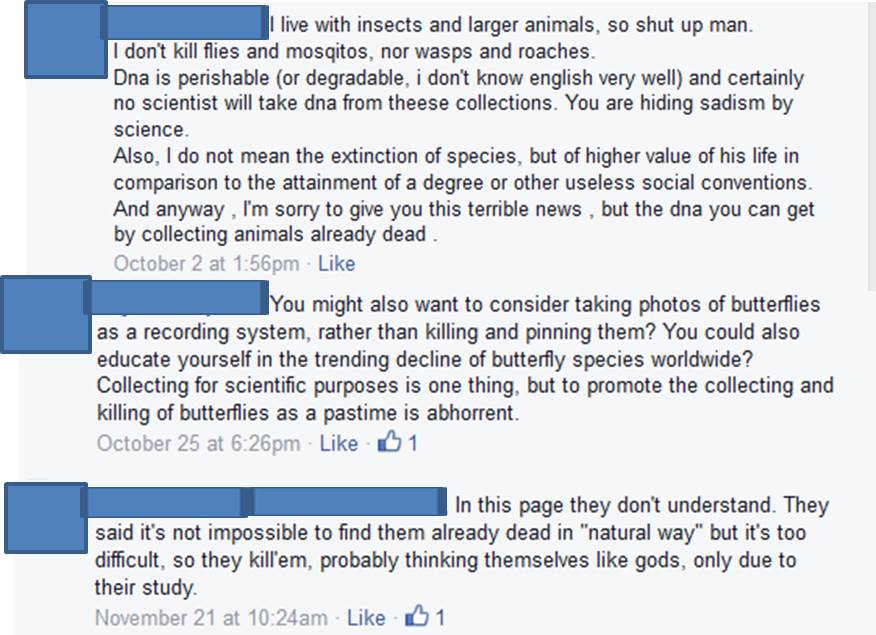
Admittedly, this isn’t really a direct user submission per se, but it’s a question which comes up in the entomological world enough to warrant a discussion. Collecting of insects is not controversial amongst entomologists, but seems to strike a chord with many people who are interested in entomology. There’s the perception that entomologists are like big-game hunters and kill insects simply as trophies. Some of the comments regarding this topic can be quite… passionate …and there’s been a lot of heated discussion about why people collect and kill insects.

Why do entomologists kill insects

Anti-collecting comments from Facebook Entomology group, posted under undergraduate collections. First three easily legible comments were chosen.

The reality is a bit different from the perceptions of the posters above. Insects are collected for many reasons, and killed for many more. Taxonomists, the entomologists who describe new species and classify life into systematic groups, often bear the brunt of the blame for insect-killing. Consequently, there’s been a lot of discussion on the internet by taxonomists who explain why collecting is essential to science.

This butterfly is endangered not because of collecting, but because the city of Albany New York was plopped on top of it's restricted and specific habitat.  Hollingsworth, J & K - U.S. Fish & Wildlife Service National Digital Library: WO-5309-020

The Karner Blue Butterfly is endangered not because of collecting, but because the city of Albany, New York was built on its specific habitat. However, now that it is endangered, collections are illegal without permits.
Hollingsworth, J & K, Public Domain

Many people are concerned that scientists are helping lead to the destruction of insect species, however the few specimens that scientists do collect for research purposes are not contributing to species loss. A much more pertinent threat to insects is habitat loss and degradation. The posts we linked to are our favorites which explain why killing insects is essential to preserving them, as paradoxical as it may seem.

While taxonomists have done an excellent job of discussing why they collect insects, there’s been a lot less attention to why insects need killed in the course of education, pest control, and research…and that’s what we want to mention in this post.

We want to discuss the reasons entomologists kill insects in order to further the understanding of their biology among the public, to insure the survival of our agricultural systems, insure our own survival, and so we can further our understanding of their biology.

Continue reading

Posted in Education, Research, Taxonomy | Tagged , , , , , , , , , , | 18 Comments

What does an osmeterium smell like? Does the smell differ between species?

Written by Joe Ballenger

After our initial launch, we had a number of people submit questions. One of the first, from Antnommer on Twitter, I found particularly interesting because it aligns with my interest in biochemistry.

To answer this question, I think I need to split it into 3 parts:

1.) What is an osmeterium?

2.) What does it smell like, and does the smell differ between species?

3.) What chemicals give the osmeterium it’s characteristic odor?

Continue reading

Posted in Chemistry, Physiology | Tagged , , , , , | 10 Comments

Is the Smallest Multicelled Organism an Insect?

Written by Nancy Miorelli

https://twitter.com/CharlesSimmins/status/544696298822443009

Well, in short. No. It’s actually a microscopic, parasitic zooplankton that attaches itself to the outside of other zooplankton.
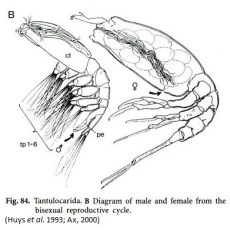
Stygotantulus stocki is the smallest recorded animal

Stygotantulus stocki is the smallest recorded animal.

Meet the crustacean Stygotantulus stocki, which measures in at just under 0.1mm (94µm).
What does that mean for scale? Well, an average human hair is about 75µm thick, so it’s slightly fatter than that.

But what is the smallest insect? That award (currently) goes to the male Dicopomorpha echmepterygis  fairyfly (Mymaridae) [which is actually a wasp, not a fly]. This species lays its eggs in bark louse eggs [Psocoptera] and is only slightly bigger than S. stocki, measuring 0.139mm (139µm).

So this little critter is smaller than two human hairs put together.

The wingless male Dicopomorpha echmepterygis. The smallest known insect (Huber et al. 2013).

Interestingly, while the male Dicopomorpha echmepterygis is wingless, most fairyflies are so small (0.5-1.0mm) that they have little feathery structures for wings that help them float on air currents.
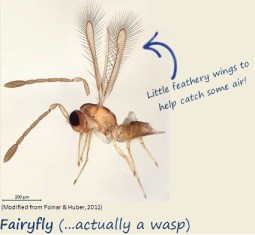
The fairyfly floats on air currents with its little feathery wings.

The fairyfly floats on air currents with its little feathery wings.

References:

1.) Morris S.C. (2006). A X , P. 2000. Multicellular Animals, Volume II. The Phylogenetic System of the Metazoa . xxiv 396 pp. Berlin, Heidelberg, New York: Springer-Verlag. Price Euros 229.00 ( VAT at local rate), SFr 387.50, £176.00, US $241.00 (hard covers). ISBN 3 540 67496 3 A X , P. 2003. Multicellular Animals, Volume III. Order in Nature – System Made by Man . xii 317 pp. Berlin, Heidelberg, New York: Springer-Verlag. Price Euros 179.95 ( VAT at local rate), SFr 304.50, £138.50, US $199.00 (hard covers). ISBN 3 540 00146 8, Geological Magazine, 143 (01) 141. DOI: http://dx.doi.org/10.1017/s0016756806271942

2.) Mockford E. (1997). A new species of Dicopomorpha (Hymenoptera: Mymaridae) with diminutive, apterous males., Ann. Ent. Soc. America, (90) 115-120. DOI:
Posted in Developmental Biology, Ecology, Evolution, Physiology | Tagged , , , | 1 Comment

Hello, and welcome!

Welcome to our website, Ask an Entomologist!

This blog is an experiment in science communication. Most science bloggers write about events in the news, or about scientific discoveries which interest them. The authors of this blog, however, want to take another approach entirely.

Instead of writing about the stuff which interests us, we want to write about the stuff which interests YOU. The content of this blog is (almost*) entirely user-generated, and we want to answer the questions about insects you have.

You can meet our authors here, and submit questions here. You can also follow us on Facebook, or Twitter at @BugQuestions if you’d like to submit questions through there.

*In order to build a blog with entirely audience-generated content, we kind of need an audience first. While we’re waiting to build an audience, we’ll post articles generated by the authors. Eventually, we’d like to switch over to a user-generated content model.

Posted in News | Leave a comment