What’s going on with the bugs at Burning Man?

A couple days ago, we got a tweet about some bugs which were swarming in Nevada. I didn’t realize that it would become a national story at the time, but now they’re swarming all over people, biting everyone and just making this normally fun festival a rather unpleasant experience.

Friend of the blog Doug Yanega gave an interview with NPR about these bugs, and Gwen Pearson has written about them as well.

There’s a couple different insects involved with this swarm. Those big, green stink bugs are probably a Nezara viridula. The two smaller ones are a Lygaeid, Nysius and another Mirid whose identify is uncertian.

Some of these insects feed on mustard plants, and keep the compounds in their bodies to remain distasteful to predators. So if you crush them, it’s basically like caking yourself in pure wasabi. In high concentrations, those chemicals can make for some pretty nasty burns.

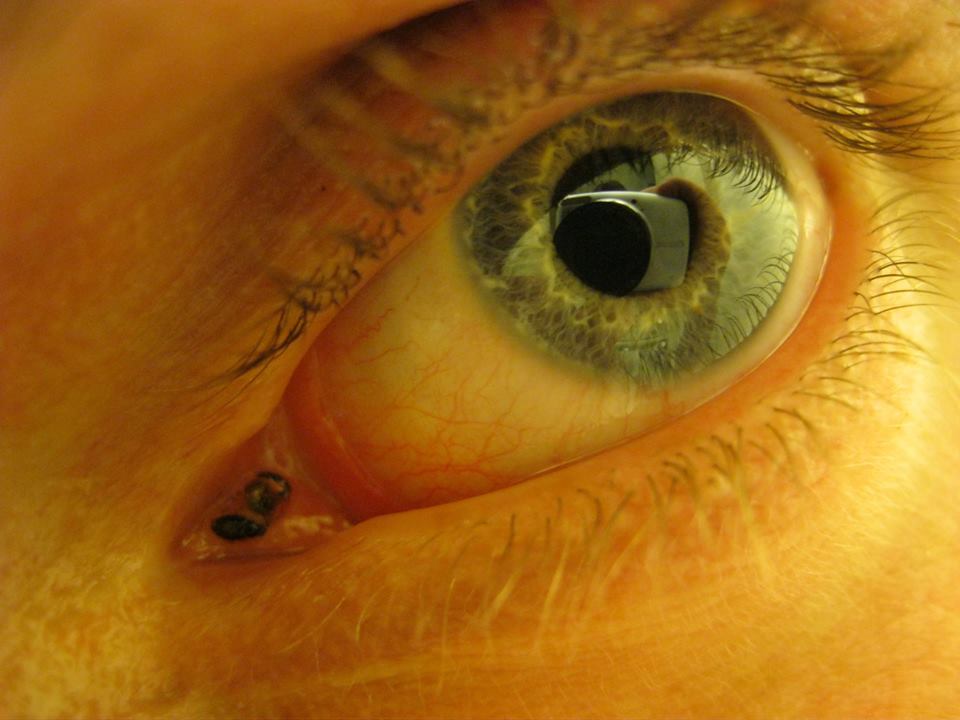
Those Mirids, however, are probably biting people. Mirids aren’t particularly bright insects, and will probe whatever they land on to try and see if they can eat it. I’m working with another closely related bug in this family, Lygus, and I have to be really careful not to let too many of them escape to avoid being bitten.

It’s important to note that they don’t feed on people, although they may supplement their diet with other insects very occasionally. They don’t spread disease, either. Unfortunately, beyond insect repellent (which might not work), there’s not too much that can be done to avoid bites.

This is sort of a freak situation, the right conditions which bred bugs at a time which just so happened to coincide with a large group of people.

So it’s a rather interesting insect-related thing which will probably be over as soon as the insects move on to another food source.

Posted in Culture, News, Pest Management, Taxonomy | Leave a comment

Why is this chrysalis always dripping?

Post written by Joe Ballenger

This post is going to be odd, because I’m going to start with a confession:

This question initially stumped me, and it actually took me a couple weeks to fully figure out what was going on here.

It stumped me for one main reason, and that’s because the answer turned out to be an insect identification request where the key characters had little to do with the pictures I was sent. The clues which allowed me to identify the insect, and explain the picture below, were actually given to me during the correspondence and I initially overlooked them.

So here’s the original message we received from a reader named Katharine:

Your Name: Katharine
Your Bug Question: So, I planted a monarch garden a while ago, and I’ve been lucky enough to get at least two monarch chrysalises. The thing is, they’re often wet and dripping, even when the grass around them is dry. What’s going on here?

She also sent us a picture of the chrysalises. One of them looked normal, but the other one was dripping:

OLYMPUS DIGITAL CAMERA

The one which looked normal just so happened to have a small wasp hanging out on the side.

Monarch parasitoid

She later told us that the Chrysalis produced several small wasps, and managed to photograph two of them:

Pteromalus

So what’s going on here? Why is this chrysalis perpetually dripping wet?

Continue reading

Posted in Behavior, Developmental Biology, Ecology, Physiology | Tagged , , , , , , , | Leave a comment

Do wasps bite, and does their saliva have any defensive properties?

waspquestionToday’s question comes to us from a friend of mine, through a conversation on FB instant messenger.

Wasps are a huge group, and at least 150,000 types of bees, wasps and ants have been described by scientists. Despite the fact most associate the term ‘wasp’ with ‘painful sting’, the number of species that can actually sting humans is pretty small compared to the rest of the order. In fact, a lot of these insects have actually lost their stingers.

The group most people think of when they talk about wasps, the Aculeates, are actually about 30% of the total wasp diversity. The vast majority of species are either incapable of actually stinging people, or just not encountered by people (other than entomologists) to where a sting is really an issue.

So I’m going to pick a group I’m familiar with-the paper wasp genus Polistes-because it’s the stinging wasp that’s most commonly encountered by people. I’m also going to be discussing honeybees, since this is the group of Hymenopterans which most frequently stings people.

So today’s post is going to be about spitting, stinging and biting.

You know…all the fun things wasps do!

Continue reading

Posted in Behavior, Chemistry, Ecology, Evolution, Physiology, Pollination, Research, Taxonomy | Tagged , , , | 8 Comments

Adventure Time! In The Rain Forest!

Written by Nancy Miorelli

Posting for the next week or so may be more sporadic than usual. We try very hard to post twice a week usually around Monday/Tuesday and Thursday/Friday. We totally appreciate you and your patience as Joe and I juggle busy schedules.

But it’s about to get busier. Joe is working on some super secret job stuff (He’s probably Ant-Man or something).

I am leaving to go live in the Ecuadorian Cloud Forest for six months tomorrow. I’ll be doing what I love most. Being surrounded by nature and geeking out to anyone possible about how awesome our planet is (particularly the bugs).

We don't make leaves like this here

We don’t make leaves like this here

Continue reading

Posted in Ecology, Education, News | Tagged , , , , | 1 Comment

A Bug Landed On Me. Now What?

Written by Nancy Miorelli

This question came in from our email.

Your Name: Su
What is the best thing to do when an unidentified bug lands on or is crawling on me?  Panic and just Get It Off or stay still?

Imagine, you’re sitting outside enjoying your refreshing drink of choice, when suddenly a wasp lands on you. Or some other unknown bug. Now what?

Hitchikers


The best thing for you to do is relax and be calm. Insects and their allies (spiders, scorpions, etc…) can tell when you’re nervous or agitated. If you start moving around and swatting at them, this will agitate your bug further and could lead to some painful biting or stinging. As hard as it is, just take a deep breath, stay calm, and wait for it to fly or walk away.

This synopsis excludes the insects that are landing on you because they’re parasitic. This also excludes extreme situations, like if you run into a hive or disturb a nest of wasps/bees/ants. If you do that, you should definitely get away as quickly as possible.

You should't aggravate a hive, but generally if you leave them alone - they'll leave you alone.

You shouldn’t aggravate a hive, but generally if you leave them alone – they’ll leave you alone.
PC: Nancy Miorelli

Continue reading

Posted in Behavior | Tagged , | 3 Comments

Honeybee genetics: how do they work?

Your Name: Farhad
Your Bug Question: Hello. I read in a book that worker bees are clones. But how this can happen? Can you explain?

Tonight’s question comes from Farhad, who emailed us and asked how bees can be clones. It’s important to note that it’s the male drones, and not workers who are the clones. Drones are a type of clone, because they’re produced asexually from unfertilized eggs. Workers are produced sexually from fertilized eggs. This is called haplodiploidy, where males only have half the chromosomes of females.

In any organism, the males and females are going to be different by definition. Most organisms, including humans, have to be capable of producing two different types of organisms from the same set of genes. You can see a lot of these differences pretty easily, and Nancy hit on this in the post Is That Bug a Boy or a Girl.

Tonight, we’re going to go a lot deeper into that topic.

Continue reading

Posted in Chemistry, Developmental Biology, Evolution, Physiology, Pollination | Tagged , , , | 7 Comments

Chemical Warfare and Evolution

Written by Nancy Miorelli
Jon and me outside of Ciné after our talks! PC: Chris Parsons

Jon and me outside of Ciné after our talks!
PC: Chris Parsons

Just this week I had the unique opportunity to give a joint presentation with Jon Perry from Stated Clearly. Jon and I worked for several months together, in combination with a team of other scientists and communicators to create this video: What Is Chemical Evolution? sponsored by the Center of Chemical Evolution in Atlanta. Jon was flown out here to give several talks within the Atlanta area and invited me to present with him in Athens.

Jon first talked about a little of the history regarding Chemical Evolution and I followed up with a brief look into how chemicals are used in different insect and arthropod groups. I hope you enjoy it!


Chemical Warfare and Evolution
My talk ends at 22 minutes, the rest is questions. All credit and references are posted past the “more” tab. Thanks for watching, and I hope you enjoy! Make sure you have annotations turned on! (unless you’re on mobile in which case they’re automatically deactivated.)

What Is Chemical Evolution

Continue reading

Posted in Behavior, Chemistry, Physiology, Taxonomy | Tagged , , , , , , , , | 1 Comment

What insects are entomologists afraid of?

Written by Joe Ballenger

Your Name: Jessica
Your message: Just wondering if entomologists feared any insect bug or other creatures with lots of legs? I’m recently freaked out but monster freaking demon camel crickets so pretty much every cricket is a nasty camel cricket to me.

So, first and foremost, I want to point out how much I LOVE this question. It’s our fears that play a big role in making us human, and scientists are human…so scientists get scared of stuff, too. We routinely work with stuff that scares a lot of people, so does it make sense that we get scared of bugs as well?

…and the answer is yeah, there are entomologists who are scared of bugs. It’s a lot more common than anyone realizes, and I’m not sure why people don’t talk about it more often. This is usually a simple phobia, but there are some very legitimate reasons to be somewhat afraid of the bugs you work with.

Entomologists have some...weird occupational hazards. Picture credit: Joe Ballenger

Entomologists have some…weird occupational hazards.
Picture credit: Joe Ballenger

Continue reading

Posted in Behavior, Education | Tagged , , , | 19 Comments

How do I become an entomologist?

Post written by Joe Ballenger

Your Name: Catherine Mitson
Your Bug Question: Hello!

I am an undergraduate student studying Conservation Biology at the University of Exeter but my main interest is in insects and I would love to go down the Entomology route! Do you have any experience/advice that could help me in pursuing a career in all things insect related? I have always imagined that I would stay in research (and so right now I am looking at Masters programmes) but I am clueless in how to gain more experience and knowledge.

Thank you for your time!

Catherine

Through this blog, our personal Facebook pages, and the groups we moderate, we get a lot of questions about how to traverse the educational process. It’s a really tricky system, because you can go to school and still have no clue how to get into career field you want to get into. Getting into undergraduate isn’t particularly difficult, but there’s significantly less guidance for what to do once you decide you want to continue your education.

There are a lot of things to consider, from the internal pressures which come from this sort of job, to things as simple as navigating office politics.

So where should you begin?

It all begins with us telling you some deep, dark secrets about ourselves.

Continue reading

Posted in Education | Tagged , , | Leave a comment

What Is That Bug? Thank a Taxonomist!

Written by Nancy Miorelli

We normally reserve our energy for writing about insects,  but we often get inquiries asking us to identify insects. This isn’t our main purpose. We’ll help you as far as we can and then refer you to other blogsFacebook groups, and websites where entomology experts are normally lurking. Regardless, if you send us or anyone else ID requests please follow these guidelines to ensure the most refined and accurate identification.

Please don’t take this the wrong way. We *want* to help you, we’re just not qualified. Insects make up 58% of the biodiversity on the planet, with beetles alone consisting of over 350,000 species. People who study scarab beetles may not even have the expertise to help you identify your sap beetle. Joe and I are just two people, and two people just can’t know all the bugs. That’s why we refer you to places where many people with various areas of expertise are present.

But with all of that stuff out of the way, we (entomologists, enthusiasts, scientists) can only tell you what your bug is because of taxonomy.

Taxonomy is the science of classifying, organizing, and naming organisms. I can tell you that a Cardinal is a Cardinal and a Cheetah is a Cheetah because of Taxonomy.

Taxonomy is a scientific art that is being lost, but shouldn’t be. It’s one of the most important, but under appreciated, sciences of our time. Taxonomists and naturalists like Charles Darwin and Carl Linnaeus were heroes of their time. However, modern day taxonomists are struggling for both recognition and funding.

Today, I’m going to take some time here to explain what taxonomy is, how taxonomy helps us ID things, and why sometimes it’s impossible for us to know what you have.

Continue reading

Posted in Taxonomy | Tagged , , , | 3 Comments