Written by Joe Ballenger
I’m still following the Zika/Microcephaly literature. I’m not writing about every paper which comes out, but I am writing about the ones I feel are pretty important. The most recent ‘big paper’ came out in the New England Journal of Medicine in mid-April. The paper, cited below, purports to definitively connect Zika and microcephaly.
Correlation VS Causation
When writing about medicine it’s important to separate correlation and causation, and explain why it can be complicated to separate the two. Figuring out whether one thing causes something else can be tricky, because things can be related without directly interacting.
The classic example of a correlation which isn’t causation are ice cream sales and car accidents. Ice cream sales decrease during winter, while car accidents increase. It would be-to put it lightly-a stretch to conclude that eating ice cream will protect you from car accidents. Instead, the relationship has to do with weather. Cold weather changes ice cream consumption patterns, and results in bad road conditions. So there’s a relationship there, but one doesn’t cause the other.
However, one would expect something that causes something else would have a strong correlation. A good example of this is honeybee hives and honey production. More honeybee hives means more honey production. I used the website Spurious Correlations to make a graph of this exact scenario:
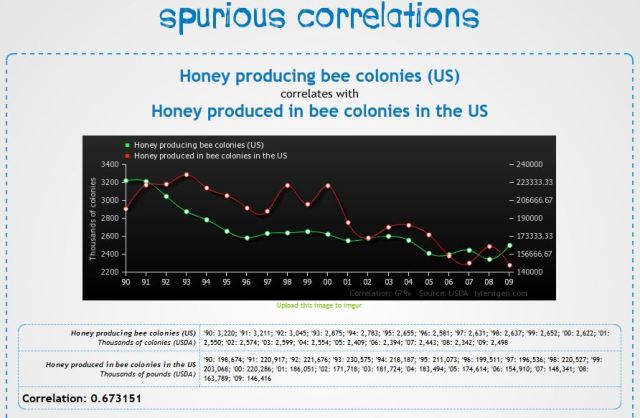
Yes, Joe used Tyler Veigen’s website to generate a correlation that makes total sense. This is just about the nerdiest thing you could do. Image Credit: Spurious Correlations, courtesy of Tyler Veigen. License info: CC-BY-4.0
In this case, the correlation explains about 67% of the data. This makes sense, because honey production depends on things like weather and availability of flowers. In other words, it varies based on a lot of things. So a correlation of 1, which would be a perfect correlation, isn’t really expected. In contrast, the number of Political Action Committees (PACs) in the US has a much higher correlation with the amount of honey produced…about 90%.
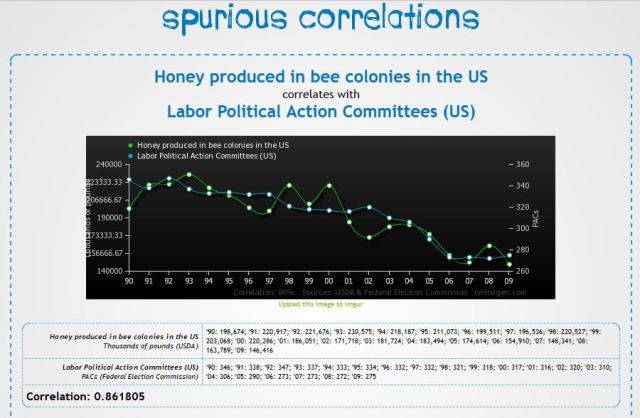
Spurious Correlations is a strangely addictive website. Image Credit: Tyler Veigen. License info: CC-BY-4.0
People who donate to political action committees don’t make honey, but the number of PACs is more closely correlated with honey production than honey producing bee colonies. These two things are completely unrelated.
So correlation doesn’t necessarily mean causation. However, things which have a causal relationship (e.g. one causes the other) should be correlated. Correlation is needed to prove causation, but strong correlations don’t necessarily prove causation by itself.
So this begs the question: what does prove causation?
Continue reading →





 Ask an Entomologist
You must be logged in to post a comment.