For our final #KidQuestions post, I thought it would be fun to tackle a question submitted to us by Bridget Mendel’s first grade class:
How do wasps find their hosts?
This is about how old I was when I first got really into insects…right about first grade or so. Picture credit: Joe Ballenger
I got my start in entomology by going through a bug phase, which wasn’t really appreciated by my parents. I raised caterpillars for fun, but they demanded I kept them in the garage…for some reason. Even at the age of 6, I knew that caterpillars weren’t supposed to turn into wasps. More often than not, I got wasps instead of butterflies.
This means that those wasps were able to find the caterpillars not only in the enormity of the entire world, but also through a closed garage door.
So how did they do this? How did they find those caterpillars against impossible odds?
Lots of people are curious and want to know if the animal they’re looking at is a boy a girl. You can’t tell the difference with every animal just by looking at it. If you can tell the difference based on how it looks, it’s called “Sexual Dimorphism“. That’s fancy talk that basically means “Two Morphs Based on Gender.”
So let’s get to the original question at hand.
@SciBugs We just started studying the Orchid Bee in our first grade class. We are wondering, are the females green and the males blue? Thnks
People are good at seeing color and so we tend to think this is an important feature when looking at animals. And in some cases, it works out! Lots of male birds are different colors than their female counterparts.
Here are a couple of ducks showing this. It’s really common in birds. The left one is male. PC: Francis C. Franklin (CC by SA 3.0)
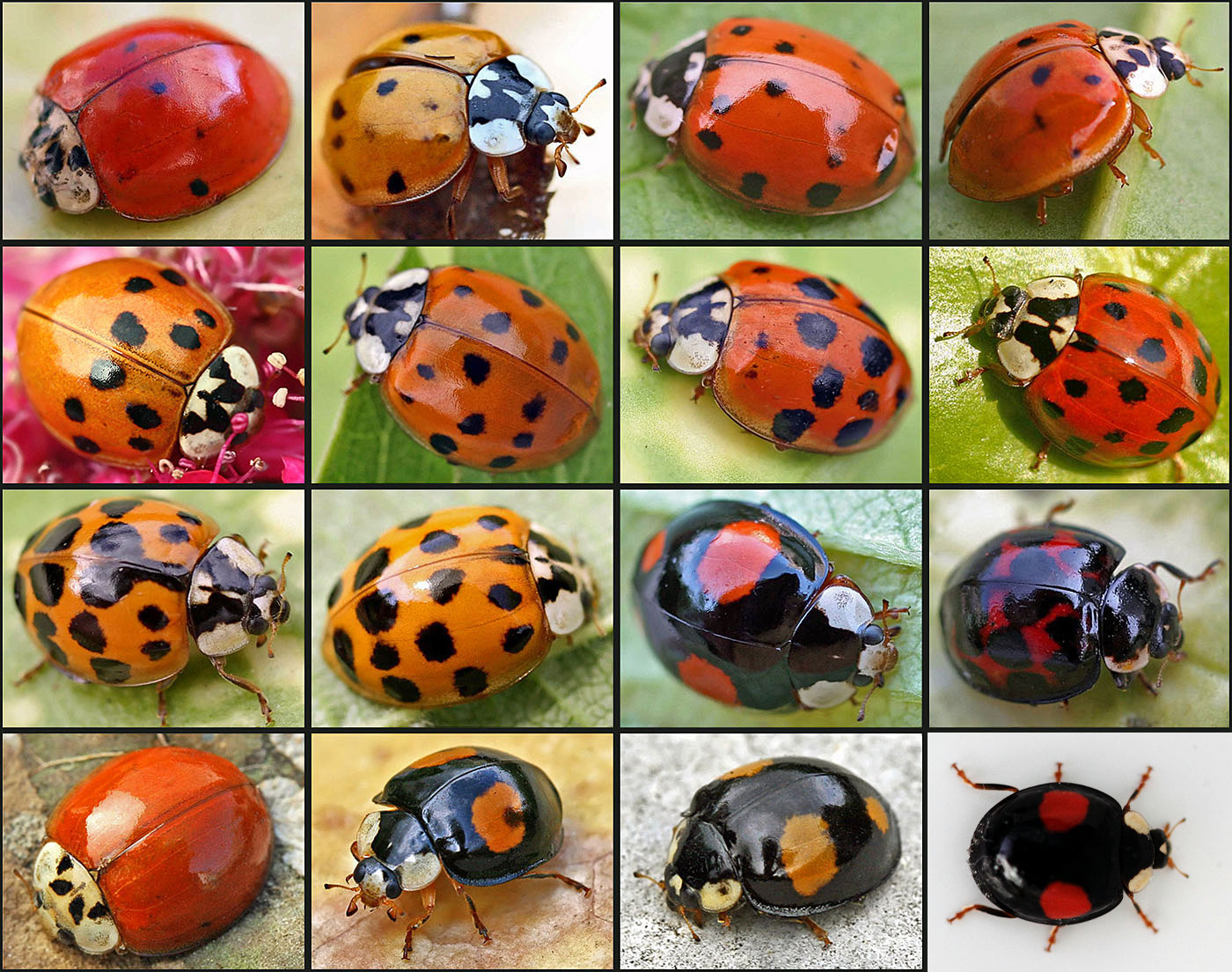
With lots of butterflies you can tell boys and girls apart by their colors, but for a lot of other bugs this just isn’t the case. Take a look at the ladybugs below. They’re actually all the same species and you can’t pick boys from girls based on their color either.
Good luck. We’re all the Mulicolored Asian Lady Beetle. Just like how dogs that are the same breed can look different, these ladybugs do too. PC: entomart
So let’s start off with the orchid bee, and then buzz through the rest of the bugs that you can tell apart.
We have to get something out of the way first. A lot of people use the word “poisonous” to mean “It hurt me more than just a bite and I could probably die”.
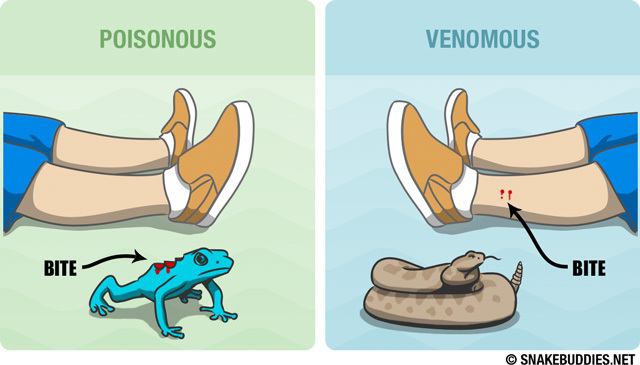
However, “Poisonous” and “Venomous” have very specific definitions which is summed up perfectly in this comic by Snake Buddies. However, you should read their full explanation as I can’t spend much time on it.
Lots of bugs are poisonous, but you probably don’t go around eating bugs. PC: Snake Buddies
So before you ask if something is poisonous, ask yourself 1) Did I try and eat it and die? 2)Did it try and eat me and I died?”
I’m having a guess that you probably don’t go running around popping bugs in your mouth like skittles, so I’m mainly going to talk about venomous insects that are more likely to hurt you, specifically.
That being said, here in the US we’re lucky because we don’t have too many serious bugs or other arthropods that can kill you, unless you’re an unlucky individual with severe allergies.
Question submitted by Bridget Mendel’s first grade class.
Fire ants are a really big problem. They’ve got a really nasty attitude towards both people and other bugs. They’re really common, and it’s too easy to step in their nests.
A lot of people get hurt by accidentally stepping on fire ant mounds, but unfortunately a lot of people confuse harmless ants with fire ants.
So how can you tell a fire ant nest from a harmless bug nest?
1.) Location
Fire ants aren’t going to be found everywhere. They’re native to tropical parts of South America, so they don’t overwinter very well. In the southern US, they’re the most common ants. However, they’re not found in the Northern US at all.
The image below is from the USDA, which keeps records of where fire ants are found. Their range is slowly spreading north, but if you’re further north than Missouri…you won’t have a problem with them.
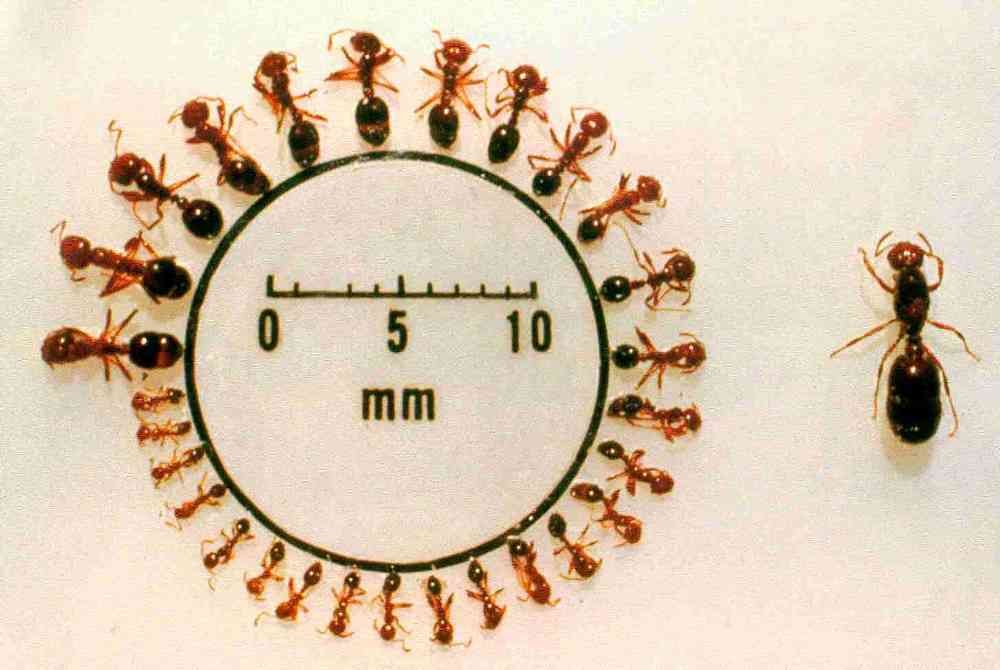
Fire ants are pretty small ants, typically about a quarter inch long. They’re also a rust-red and not a bright red. You have to look at big photographs to really see their colors. When tromping around in the grass, they look black to brown from far up.
There’s a great picture floating around the internet which shows the colors and the size of the ants. It can be seen here. Unfortunately the image is copyrighted so we can’t post it on this blog, but it’s worth checking out.
Larger red ants sometimes confused with fire ants, but these are typically brighter red than fire ants.
A red carpenter ant, Camponotus castaneus. This common species is sometimes confused for fire ants. Compare this species to the pictures in the link above. Picture courtesy of myrmecophile77, via flikr. License info: CC-BY-NC2.0
3.) Nest mound shape
Lots of ants make a nest with one entrance and exit, but not fire ants. Their nests are really big and don’t have a hole in the top. They look like a floofy mound of dirt, and can be either hard or soft depending on where they’re building.
Textbook fire ant mound. Image courtesy of Robert Nunally via flikr. License info: CC BY 2.0
4.) Behavior
Fire ants have a very unique defensive behavior. When their nest is disturbed, they pile out of their nest and start indiscriminately attacking everything that’s nearby.
Obviously, I don’t want to encourage people to harass fire ant nests…but if you live in the south and you find an ant nest looks like the one in the video above, then it’s best you avoid it.
The Bottom Line
We’ve talked about how scientists figure out which bug they’ve got before by using documents called ‘keys’. However, you don’t need to bring a key with you when you’re tromping around outside.
To recognize fire ants, you need to pay close attention to your surroundings. If you’re in the south, and you find an ant nest which matches what you see above…then it’s probably a fire ant nest.
All bugs should be treated with respect, and this goes double for any insect which is capable of hurting a human. Keep your distance, and consult a pest management professional for advice on control options if this is needed.
@UKLadybirds How unusual are half-and-half ladybirds like this? It looks pretty unusual to me but was just wondering https://t.co/Z9rGBOZT6X — Andrea Davidson (@andrea_davidson) May 5, 2015
We’ve gotten a lot of questions about ladybugs which are half yellow-brown and half red. This isn’t a normal situation by any means, and it only happens in maybe one in every ten-thousand beetles based on what I’ve seen while raising ladybirds. It’s an example of a deformity, and an interesting one at that.
So what’s going on here?
There’s two things which could be happening in these pictures, and I can’t say with certainty which one of the two choices it is. However based on what’s known about ladybug coloration, I believe this is an injury which happened while the beetle was squeezing out of it’s pupa.
Nancy has written a little bit on what makes bug colors, but this type of color requires us to explain how these colors get there in the first place.
How do you know if a bug has been discovered before?
-Bridget Mendel’s First Grade Class
Entomologists have a pretty impressive ability to identify whatever’s put in front of us. It’s a major part of our job description, whether we’re working in agriculture or academia. In fact, most of the things we get asked about are about the insects people find on a daily basis.
@bridget_mendel@SciBugs That is a red palm weevil, a really important introduced pest to palm trees.
Knowing what these bugs are means that someone has discovered them before. Bug scientists are still finding new kinds of bugs every day…so how do we know if a bug has been found before?
There are a lot of bugs on the planet. We currently know of about one million species.
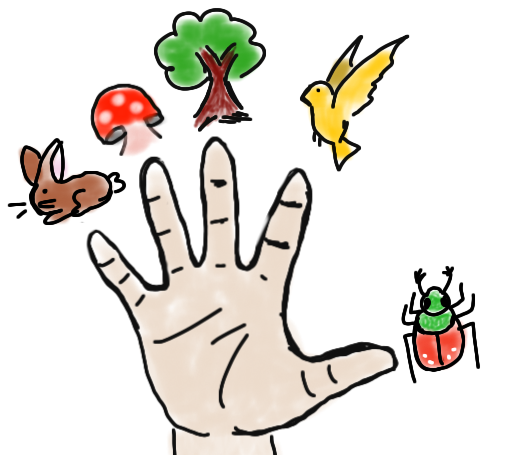
Beetles alone make up ¹/₅ of all known specieson earth! So if you were to name every species on your fingers, every time you got back to your thumb, it would be another beetle.
There are a lot of beetles… PC: Nancy Miorelli
And these are the ones we *know* of! For how many we have left to discover, it’s anyone’s guess – but current estimates are that there are between 5 and 10 million more insect species left to find.
So there are a lot of bugs. So hiring like a million scientists to run around and count every single bug of every single species is a bit out of the question. But we can make some pretty good guesses instead.
First, let’s get a short list of possibilities. There are lots of bugs, but not very many live in groups. And of these, only a few types of insects live in large groups.
Bees and ants immediately come to mind.
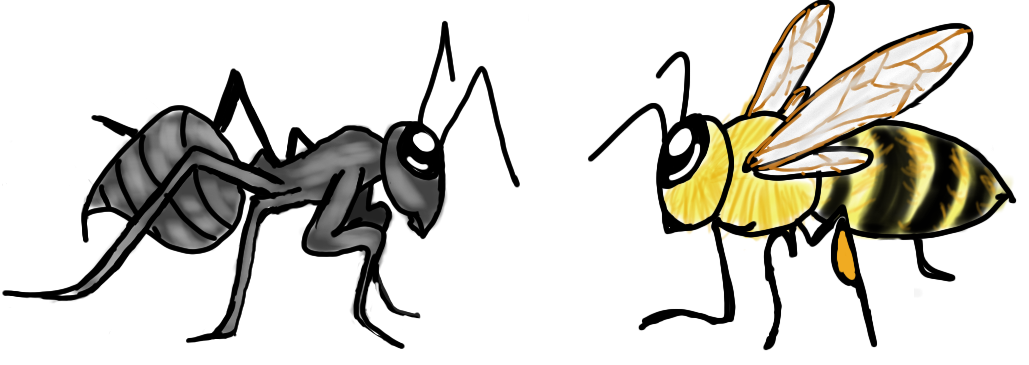
Which one is it? PC: Nancy Miorelli
But wait, there’s a surprise contestant!
Where are my eyes? Well, actually, I don’t have any and am blind. PC: Nancy Miorelli
For the month of May, Nancy and I decided to focus on questions which were submitted by parents and teachers on behalf of kids. We’ve had a lot of opportunities to talk to kids, whether it’s through skype classroom visits or just through our webpage, and they’ve asked us a lot of questions that demonstrate a lot of curiosity and thought…and we wanted to reward that somehow.
Joe and Nancy speaking to Bridget Mendel’s classroom about insects.
We have a bit of a soft spot for budding scientists, and a love of science starts in childhood. Children are obviously very curious about the world, and make all sorts of neat observations. They think about the natural world, and often they approach questions the same way a scientist would.
Unfortunately, understanding some things requires a certain familiarity with vocabulary. Anybody can understand any concept in science if someone takes the time to properly explain the topic. Explaining the topic requires code-shifting, which is a replacement of a complex and specialized vocabulary with a less complicated vernacular.
In order to show us what they knew about insects, Mendel’s class designed insects for us. The kids did a pretty good job of incorporating things like looks and sounds into their creations. Often, these were based on insects they knew a little bit about.
If someone came up on the street and asked me a question, it wouldn’t do them any good to explain it to them like I would explain it to a colleague. Instead, I’d need to slow it down and make comparisons they’d be more familiar with. That’s why a lot of the posts on our page are written at a high school reading level or below. When answering these questions, we like to answer them as we would if we were talking to our readers.
So with that in mind, you might notice our posts are a bit different this month. It’s something we’re doing on purpose. We want to explain these topics to the people who are asking the questions, using vocabulary they’re likely familiar with. In particular, there are two things about our posts we’re going to change for the month.
Mendel’s class keeps in touch by tweeting updates, pictures, and questions at us. Some of these pictures, like this one, will be the topic of this month’s articles.
First, all of our posts are going to be written at a 3rd to 5th grade reading level. Our vocabulary will be less precise (e.g. use of the word ‘bug’ for non-hemipterans), our sentence structures will be a lot more simple, and words will be much smaller. This is to ensure that kids would be able to read the answers to their questions with minimal adult input.
Our posts are also going to be shorter than normal, to compensate for the reduced attention spans of kids. Complicated questions require longer explanations, but we’re going to try to keep our posts below 1,000 words.
These changes aren’t permanent by any means. This is an experiment for us, and we want to see how well it works. Our audience is important to us, and this is one way we believe that we can best serve our readers.
So stay tuned to read about the sorts of things kids think about!
The great thing about being on social media is that we run into a lot of questions and conversations that are very closely related to each other despite the fact that the participants might not realize it. Take this question…
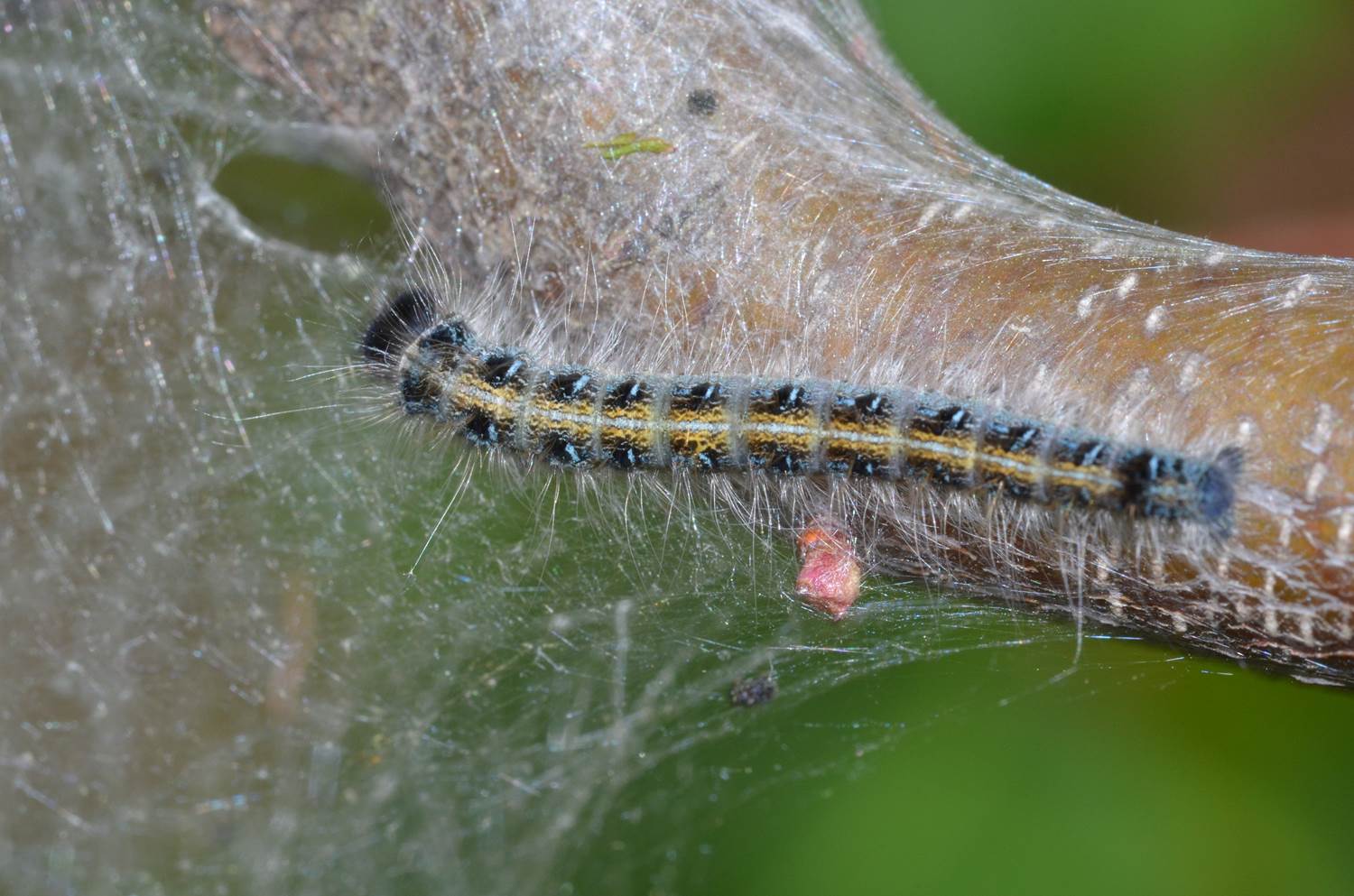
The Eastern Tent Caterpillar will be the subject of this post. It’s a very pretty caterpillar, but it has a bit of a dark side. Picture credit: Andy Reago & Chrissy McClarren, via Flikr. License info: CC-BY-2.0
…as a prime example. These posters are talking about the effects of caterpillar hairs on two different parts of the body. So, believe it or not, these questions are actually very closely related.
At first glance it would seem that this is a very odd combination of topics to cover in a single post, caterpillar defenses and spontaneous abortion in horses. How this happens, and why it happens, are directly related to how and why caterpillar hairs cause itchy reactions in people who carelessly handle them.









You must be logged in to post a comment.